Monday, February 16, 2015

Ring of Fire


As we begin our trips, we seek to stay open to learning what the earth and its populations have to share with us.  We are never sure what will emerge to fascinate us in a given place.  So far, this trip, we have been drawn to "the Ring of Fire."  About 75% of the world's volcanoes and 90% of the world's earthquakes occur in this aptly nicknamed region where plates collide and the earth shudders and erupts under the pressure of unimaginable forces.  We have wandered this region through much of our past two years of travel.  We have felt the tremors in Alaska and been welcomed our first night in Costa Rica by our host yelling "come outside" as he ran outside past us as lamps swayed.  We were in Peru and Chile for shakes and shudders, but missed the severe earthquake in the Philippines that caught our good friends, the Vopnis, and the lovely people of Bohol Island in its destructive waves of undulating power.  In Indonesia we met a team of emergency response planners helping to rebuild areas that had been crushed by the Ring's power in the past and helping to better prepare its citizens for their inevitable future.  We gazed on a changed Christchurch, New Zealand, and a still heavily damaged and destroyed Conception, Chile, after their 2011 and 2010 earthquakes, and we pondered the differences in abilities of developed versus developing countries to respond to and rebuild after such incredible natural disasters.

We are not strangers to this incredible horseshoe-shaped zone which gives testament to the earth's forces and the fragility of our feeble structures and lives when the forces are unleashed.  Yet, the volcanoes of Central America have captured us, drawn us in, and fed our imaginations and fueled our curiosity.  They loom over much of the landscape, with towns frightfully close to their scarred flanks, many active, some devastatingly so.  We gaze upon their shapes, so different than most of our Rocky Mountains whose ages of volcanism are not easily understood in their current dormant slumber.  These volcanoes are young and they smolder, puffing out ominous ash clouds with steaming vents creating clouds covering their sides.   And, much to our surprise one afternoon while in Antigua, they erupt.  The ash that cascaded down on us was acrid and the air burned our eyes and noses.  Our hearts quickened to hear the news that some locals thought it was the steaming giant,  Pacaya, where we had light heartedly roasted marshmallows the day before in playful tourist activity, with little respect for the power we tempted as we unearthed its lava, young stone created just a year before, to dig deeper into the hot maul of the planet's crust.


  It was, instead, the restless Fuego (Fire) Volcano, less than a dozen miles away that with one "burp" shut down all international air traffic to Guatemala and dusted the gorgeous colonial city of Antigua with grey ash.  Antigua, like most Central America capitals we have visited in the Ring of Fire, has fallen multiple times as the earth's plates slipped and slid and cathedrals tumbled while adjacent homes crashed into ruble.


These experiences simply seemed to increase our hunger to gaze deeper into these conical forces of nature, and we hurried onward to Nicaragua where visitors can peer into a crater filled with poisonous gasses and rising steam to see the heartbeat of the planet in flowing magma as red lava bubbles to the surface.  Even the story from our local guide during the hike to the crater about his experience a year ago on Telica did not dissuade us.  The volcano erupted while he and four girls were peering over the same rim!  The story, in fact, made us more curious to experience it ourselves. People ask us about health and safety while we travel.  We get our vaccinations, take our pharmacy of western miracles with us, and are careful of where we go, who we trust, what places we wander during the day or night.  So what draws us to creep on our bellies along side tarantulas and scorpions to the edge of a volcanic crater knowing the power it is barely restraining in that one moment?  Why, as we write this, do the cones across the plains outside of our bus window beckon us with their majestic views commanding the landscape?

We can hear Johnny Cash's lyrics in our heads, knowing that there is truth to the seductive ring of fire.  His lyrics are about love, and our experiences are about landscapes; however, both lead to being drawn into something bigger and more powerful than our minds can fathom.

I fell into the burning ring of fire,
I went down, down, down,
And the flames went higher.
And it burns, burns, burns,
The ring of fire, the ring of fire.
Johnny Cash


Posted in Granada, Nicaragua.  Images are of our visit to Pacaya Volcano, the ring of fire map, the aftermath of Fuego's eruption, Sally's first view of Telica's crater and the rubble from Antigua's earthquake.


Sunday, January 25, 2015

All who wander are not lost

While you may think the title of this blog refers to our amazing journey, it does not.  Rather, it is the tale of two pairs of Chacos sandals which have traveled Central America without Sally.  Chacos are not just any sandals.  The strong hiking versions of the brand are almost indestructible stalwarts that are equally effective in the water or on the land.  We love ours so much that we get them resoled and restrapped, sending chocolate in our appreciation to the Chacos' repair team.  But we get ahead of ourselves in this tale as it really should start with Mary Poppins' bag.  Perhaps you remember it?  As the children watch, Mary pulls out a hatrack, shoes, plant, table lamp, and measuring tape among other items.  When we arrived in Mexico this trip, as our friends Stuart and Karen watched, an amazing assortment of things appeared from our packs.  Karen jokingly said she would not be surprised to see a table lamp.  With great glee, we showed her our newest gear, an inflatable Luci solar table lamp!
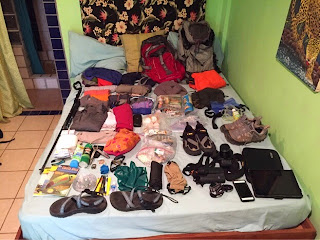
People have asked us what we bring along for our multi month international trips in our ultra light pack.  We each carry two packs, a larger REI ultralight and a daypack and they creep up to 25 pounds.  For clothing, we generally have three pairs of socks and underwear, a bandana and handkerchief, three light quick dry shirts, two pairs of zip-off river pants, long sleeve nylon shirt, light pair of shorts for sleeping, belt and money belt, R1 Patagonia jacket, a rain jacket, bathing suit, sunhat, and pair of capilene lightweight long underwear for warmth, snorkeling, or use as pajamas.  Our gear includes terrific Black Diamond carbon Z trekking poles, snorkel, mask, and watershoes (and a tiny container of dish soap for defogging), waterproof bag and pouch, headlamp, powerful lightweight flashlight for night safaris, tiny UV light for exploration and finding bed bug residue, Indonesian batik silk bedliners, our Luci tablelamp (you must see them to believe them), mosquito head netting, leatherman, small Swiss Army knives, tiny amount of duct tape, binoculars, assorted stuff sacks, sea bands, exercise bands, small lock and key for hostel lockers, headphones, short hiking gaiters, backpack raincover, ultralight travel umbrellas, neck pillow, key ring lights, maps, thank you cards, and pencil and small pad.  For electronics, we have an iPad, two iPhones, and two cameras and the necessary assorted cords.  As John Hausdoerffer would put it, we are a walking pharmacy, prepared with an assortment of over the counter and prescription medications and sunscreen (100SPF) and insect repellent.  We also have a small first aid kit with blood clotting powder, steri strips for sutures, skin glue, Benadryl, Epipen, and silver bandages.  Water and snacks, especially Sally's famous gorp with mint M&Ms are part of our load as well. Nail clippers, toiletries, glasses and contacts are included.  Ziplocks and plastic bags are invaluable.  When we travel in cold places, we have more winter gear.  And then, there are our irreplaceable orthotics, hiking shoes, and beloved Chaco sandals.

So back to the Chacos!  How did not one, but two pairs of Sally's Chacos come to wander Central America, traveling from place to place without her?  It started with her selflessly agreeing to carry our laundry during our border crossing from Palenque, Mexico to Flores, Guatemala.   We arranged the transport with a company which has different drivers on both sides of the border.  It was smooth, until we arrived at Flores and realized to make room for the laundry, Sally had accidentally left out her Chacos.  Over the next few days, including three extra ones, we stayed in great hope and yearning, while our hostel owner, two hotel clerks, the sons of two angry Latino ladies, a local guide and countless shuttle drivers blamed each other, called each other names, and all claimed the Chacos were delivered to the next person.  Sadly, after a week of perseverance and pleading, we gave up on seeing Sally's trusted companions, knowing they likely had new souls with different soles treading in her old friends.  There was a moment of renewed Chaco hope in Guatemala when Jess discovered that a small store improbably in the middle of nearby Santa Elena, sold Chacos.  In two years of travel, the only other place  we have seen them was in Darwin, Australia at an army surplus store.  We were amazed at our good fortune until we realized they had only men's size 11s and larger.  Even duct tape could not help Sally reconcile 5 sizes.

With resignation and a real sense of loss, we ordered new ones sent to Sally's sister.  We asked friends of friends in Belize City to receive two packages for us, a new bank card and our FedEx international express pair of Chacos.  The $176 shipping charge was a lot, but these are Chacos, after all.  There were a few delays, unexpected complications, and bank card issues, but finally, we heard that two packages arrived at Belize City..., a few hours after we left the city to sail down the Belizean coast.  Sally wandered the seas in bare feet and hiking shoes coveting Jess's Chacos as we strolled on coral sand beaches.  We arrived well south of Belize City to learn to our joy that for a few dollars, a local air service would courier our two packages to a local airstrip.  More logistics, the kindness of new friends and strangers and the package arrived.  Sally was dumbstuck when what was handed to her was a single, flat envelope, which we were to find out, held two bank cards (the bank sent 4 in the end, another long story and clusterama).  Jess found her sitting on the bed in quiet despair staring at the flat Chacoless envelope certain her sandals were cursed.  Her sister Sandy offered another explanation, suggesting that the sandals were not cursed, rather just being rebellious and wayward or possibly contrary and recalcitrant.

Puzzled, we checked online, following the journey of Sally's Chacos across both North and Central America to find they were being held hostage at customs in Belize City.  Despite her sister paying maximum expedited international shipping charges, strange messages appeared on FedEx tracking such as "Customer has not paid for expedited customs clearance" and "Contact third party courier" with none listed.  Neither talking to nor visiting FedEx online elucidated the issue.  But our local friend in Belize City helpfully explained that when she receives packages from DHL or FedEx, they call her for more money to release them.

So the tale of two Chacos pairs ends with a reunion for one and a peregrination for the other.  We received another text, news that there was a package on a plane, and to our delight a new pair of Chacos will walk the Jaguar Reserve at Cockscomb Basin and enter Guatemala and Honduras with us, securely on Sally's feet.

Posted in Placencia, Belize.  Images are of one of our sets of travel gear, our Luci lamp, Sally's surprise at her package delivery, and one of the last pictures of Sally's lost soles.

Thursday, January 15, 2015

What goes around, comes around.

Ruins?  Is this an appropriate label for the broken and dilapidated structures dotting the landscape in almost every part of the world?   These "reminders" of past civilizations can be mysterious, majestic, unreal, and captivating.  In our travels, we have visited some of the most well known of these ancient civilizations: Machu Picchu, Chichen Itza, Angkor Wat, Mesa Verde, Chaco Canyon, Tikal, Bagan; and we have hiked, biked, and wandered the lonely trails of many other lesser known but fascinating sites.

Visiting these ancient cities has given us enormous joy, immense pleasure, and hours of worthwhile and provocative conversation during our
travels.  While we have occasionally been accompanied by those with a rich and local knowledge of sites, we have found we generally prefer to experience and peruse sites by ourselves without a guide.  We thrive on the thrill of discovery as we wander into and through the site, finding carvings, stelae, bas-reliefs, faces, murals, or any number of other things ----- characteristics of each individual site that we have usually researched ahead of time.  Yet it is not the intellectual research that sends us forward to explore new sites, it is the quiet reflective moments that we share in silent wonder of what came before us and what shall follow.  We have stared out over ancient geometric patterns on valley floors, temples rising by the thousands on desert plateaus, secret structures camouflaged in deep canyons, fortresses on mountain tops, and pyramids in raucous jungles. Often, only our imaginations are left uncovered and unexplored as we gaze at the carefully placed rocks and crumbling mortar.

After considering each site, we have determined that all or most possess some common attributes.  All connect us to ancient civilizations but it is the ways those connections are manifested in each of us that make our experiences in visiting them so individualistic.  All have been constructed using laborious methods that befuddle our imaginations and precise, exact sciences that we are certain should never have been known during those ancient times.  Worship, if our archaeological interpretations are correct, was of the highest importance to each civilization.  A class system of some sort was usually how society was structured.  War and armed conflict, both among neighboring settlements and other locales many miles removed, were common.  Empire building seemed to be a priority as the conflicts resulted in more and more land/villages being consolidated under the rule of one leader or tribe.

Probably the most perplexing common attribute is that many of these civilizations simply disappeared......or did they?  Our knowledge of ancient peoples grows with our knowledge of science.  Studies of ancient soils, plants, animals, and weather tell us that severe drought for years or even decades devastated more than one civilization.  Other studies surmise that some peoples were simply
engulfed by a "superior" civilization and their identity ceased.  Still other evidence points to the complete destruction/devastation of the local environment and over use of resources leading to subsequent collapse.  In these times, the educated and the elite may have been the first to perish and recorded history may have halted although some life went on with locals forgetting their history or heritage.

When one looks at these ancient societies, it is difficult to avoid looking at ourselves as we exist today.  "History repeats itself" is a common saying that should make us all a little reflective about  our future.  Are "ruins" on our horizon?  Are we, too, destined to become another civilization that just disappears?  Who will gaze at our relics a thousand years from now?  What will be whole and what will be "ruined"?

Posted in San Ignacio, Belize.  Images are of Machu Pichu, Peru; Palenque, Mexico; Angor Thom, Cambodia; and Tikal, Guatemala.

Tuesday, December 30, 2014

Living Local, Going Global

Our lives have changed….again.  We began this odyssey over two years ago, climbing volcanoes and snorkeling in seas, finding ourselves, as we blogged last June, coming full circle to Gunnison, Colorado and Western State Colorado University.  We have been so lucky to have spent the last six months with a terrific, talented, and dedicated group of graduate students and faculty determined to leave the planet a better place than the one we find today.  The previous two years had given us a perspective of the importance of choosing how each hour of the day is spent, and neither of us can imagine a better group of colleagues and students with whom to do so as we “work.”

Part of our work and self-renewal is to travel.  We are in an enviable place where we are graced with meaningful work in an amazing community as we “live local,” and, just as the digits drop to the
negative degrees, can “go global.”   Our first stop was one for which we have hungered during the past two years.  We dropped into Oaxaca, Mexico to visit Karen and Stuart, two people we met for what was too short a time in Peru, and have remembered ever since.  In part, because of Karen’s kind gesture of sending her hiking socks along with Sally in her time of need, it should surprise no one that Jess is now literally wearing the shirt off of her back.  Karen and Stuart are an adventurous and generous duo who have seen much of the world, especially Latin America, and now nestle for part of each year in the arms of an amazing community of nationals and internationals in the gourmet capital of Mexico.  Oaxaca is especially well known for its chiles and chocolate, often lovingly mixed into mole.  Sacks overflowing with roasted cacao, cinnamon, and chiles are clustered in shops lining the streets as customers give instructions to men grinding pastes of the fragrant combinations and people of all ages line up for chocolate beverages, both cold and hot.  Chocolate is the blood that runs through this city’s veins in rich courses tracing its history and forecasting its future.

We have spent an amazing week in the embrace and tutelage of our knowledgeable and kind hosts, learning about their favorite small restaurantes, or the best stools in the market for guanabana nieve, or local hiking trails and spectacular world heritage sites.  And, the greatest pleasure has been learning about the lives of two people we will always treasure  as terrific friends.  However, the road is enticing us onward and our bus tickets are hot in our pants pockets as we head south towards Guatemala.  We will pause to linger in Chiapas, initiating 2015 by staring at canyon walls towering over us then board a bus to the border and onward to Lake Atitlan in Guatemala.  We will head west toward Belize where we will linger for much of January then slowly turn southward hoping to spend part of February in Panama.  For March and April, we will be exploring Costa Rica, six weeks of it as camp hosts and University representatives at the fabulous Finca BellaVista treehouse resort community.  As always, we welcome the companionship of our friends looking for adventure and willing to eat fried tarantulas with us!

Images from Oaxaca, Mexico and are of Karen gazing at an image of the stained fingers of an indigo dye maker near the Chiapas border; a worker making chocolate paste in one of an incredible number of chocolate shops, and Karen and Stuart Carter and us in a wonderful Oaxaca Lending Library.  Posted 30 December, 2014.

Saturday, June 7, 2014

Full Circle


Two years have passed. We began our worldwide two year trip on June 8, 2012 and it feels like both yesterday and a lifetime ago.   More coincidentally than planned, we have finished it on June 7, 2014. On our last night, surrounded by an old friend and new ones from four different countries, we watched the sun set over a meandering river in Bangkok.  During our two year journey, we hoped to learn with humility and give with grace as we answered the question "How do we continue to grow?"  Our hope was that the 7 billion souls and the lands they occupy would become our teachers. Each of the 365 days in the following two years was filled with new lessons and experiences.  We sought to learn as children do, with few preconceptions, with wonder, with excitement and with passion.  We knew some lessons would be harder, some would frighten us, and a few would bring us to tears.

In the end, we underestimated how special the journey would be. We have cried tears of wonder and tears of pain. We have stood in absolute awe before some of the greatest sights on earth.  We have felt the earth tremble as glaciers rumbled across its face.  We have watched volcanoes smolder and have seen the footprints of invisible snow leopards in fresh Himalayan snow.  We have gazed across salt flats and tundra plateaus possessing unearthly beauty. As we drifted through the darkness deep within the earth, Glowworms lit our way as did the stars of the milky way on the top of Chilean mountains.  We stood below the rooftop of earth, not once, but twice, gazing into the
dangerous crevasses of both the south and north faces of Mount Everest.  We have hovered above giant cuttlefish and whale sharks as they swam lazily below us.  We have stared mother grizzlies and orangutans in the eye.  We have gazed on the faces of deities in over a dozen countries, some living, some surreal.  We have walked bare foot through piles of dung and blood-red betel spit in respect for the customs and cultures of those whom we visit.  We have been burning hot, achingly cold, and every state in between in almost 20 different countries and on four different continents.   In each place, our hearts have been forever changed by the people who shared these sights with us, some leading us to them, others discovering them by our sides.  New friends and one special old one have accompanied us in our odyssey.  And some of our favorite new friends were not human, rather animals that touched our hearts and souls.

We are both smaller and larger than we were when we left our jobs, our friends, our family, and all that was comfortable and familiar.  While we have learned much about the world, we learned the most about ourselves and each other....and we are not ready to stop learning.  In fact, we hunger for greater lessons and new opportunities to grow.  The first will come as we seek to help others realize their dreams.  We did not know where we would "land" after we sold our house and most of our possessions and began this journey two years ago.  Interestingly, we have come full circle and will return to our professional passions and to our community in Gunnison, Colorado, the place we call home.

For six months a year we have been given an amazing opportunity to participate and teach within a new community of learners.  This summer, Western State Colorado University opens its doors and hearts to an inaugural group of graduate students seeking a masters in environmental management.  As we have traveled the world, we have seen so many needs and have realized there is little time for humanity to change its path of global annihilation.   We grew up in the nuclear age, ducking and covering, afraid of weapons of mass destruction.  What we did not know to fear were the consequences of the daily cumulative actions of seven billion people.  A stunning percentage of the planet is stripped of its resources, laid bare to the ravages of changing climate, with little local life remaining on the land beyond the poor who have no other place to go.  Everywhere we travel, including in our own "backyard" we see environmental challenges that must be met.  We are humbled beyond all measure to have a chance to help educate those who are stepping forward to meet these challenges with new voices, important projects, and increasingly sophisticated ideas about how to address our past mistakes and create new futures.  For six months of each year, we will be face-to-face with this emerging community and for half a year we will continue to travel, connected to our newest community and building bridges to additional ones in distant lands.

We named this blog "One hundred stories" and hoped to write at least that many during our two year adventure.  We have written only sixty so far.  It is not that there was a dearth of stories; each day was typically filled with several.  We simply found that we were often consumed with living the stories rather than writing them.  We hope to continue this blog and plan on finishing a blog posting about travel tips soon!  This adventure has finished, but the next one has already begun.

Posted in Los Angeles, California. Images are of a Nepalese woman telling Sally about her woes, the Uyuni Salt Flats of Bolivia, and of a poor family trying to catch small fish in Cambodia. 


Friday, June 6, 2014

Two paths

Two paths lie before communities we have visited in Bolivia and Cambodia.  The paths are both physical, having been laid stone by stone, as well as political, involving choices made by the governing bodies.  The paths have the same intended goal: to improve a particular area for tourism.  However, what makes us reflective is how the process of creating the paths reveals so much about people and place.

We first introduced our blog readers to Isla Taquile in Lake Titicaca almost two years ago with a story about 17 sheep.  Our homestay hosts were saving money to buy enough sheep for their island wedding celebration and were 17 sheep short of the total needed.  One element of the a Taquile society we did not write much about was the political structure.  Each of the small island districts was led by a senior married male, and there was one overall leader for the entire island. An individual's profession, where they were live, and when they were to marry were decisions made by the male leaders and the male villagers in weekly meetings.  Consensus among the married men was used to decide actions important to all.  A few years prior to our visit, the community decided to adopt tourism as a viable economic benefit for everyone, and, to assist in that endeavor, built a beautiful stone path from the beach to the highlands that would meander around homes, playgrounds, and small markets.  Each family was responsible for constructing and maintaining a 10 meter stretch.  These people who dressed with such impeccable pride in traditional hand woven clothes and knitted hats also laid each stone with artistic care.  One of the most amazing paths we have enjoyed in our travels, we encountered numerous villagers moving along its many fingers, tipping hats to each other and sharing bags of coca leaves in a formal dance of tradition and greeting.  Our host family showed great pride in the project and believed it helped provide for families in a variety of ways.  Few tourists have actually tread on the path.  We were two of only five for the two days we were there, but people greeted us with smiles and dignified grace as we traversed its stone steps.

In Cambodia we were, at first, delighted to find a stone walking path along a relatively undeveloped two mile
stretch of beach overlooking the Bay of Thailand.  However, the path precipitated questions, for us, about the repression and inequality in this country.  We had read the history of the vast depletion of the resources during and following the period of the Khmer Rouge and Vietnam invasion in the 1970's and '80's.  Cambodia had been home to some of the most prized hardwood in the world, but selling the forest became a national pastime for whoever was the ruling authority during that time. Some estimate that, in three decades, 95% of all the native trees were removed.  Even when world pressure led to moratoriums, the current leadership would provide favored cronies with "concessions" to plant Eucalyptus trees and remove the native trees.  They argued that they were no longer logging, rather, farming trees.  If local villagers protested, the army was dispatched to guard the logging operations.

With a majority of the forest gone, the government turned to a new money making scheme, selling the cleared land to both foreign and domestic development corporations.  There was just one minor
complication.  People lived on the land.  So, for the past decade, the government has solved that small problem by simply removing the residents!  Initially, with military personnel acting as enforcers, residents were simply herded onto trucks and dumped elsewhere as heavy equipment bulldozed their small dwellings, usually in a single day or night.  During the past few years, however, given the howls of protest and the complexities of dealing with hundreds of thousands of landless refugees, the government has begun to offer small payments to those "displaced" or to build new villages.  The unfortunate dilemma is that the confiscated land was usually near resources such as lakes, the sea, or tourist areas, whereas the new village locations are usually the places no one has wanted to live.

We were, at first, delighted to have a quiet footpath to walk along the beach until we heard about the villages that were removed from it in the past year.  We drove by one of the places, a few kilometers away, where the people had picked up broken wood and tin from the bulldozers and tried to piece together their lives again.  The poverty was intense, the scene heart wrenching.

In both communities, leaders decided that a path would be built.  Each community had a political process foreign to us.  Yet, the outcomes felt so vastly different.  One place had the sense of living the saying "a rising tide lifts all the boats" and the other broadened an already enormous chasm between the ultra rich and the unimaginably poor.  For us, one lesson has been to more deeply understand what lies beneath our feet as we tread new ground in places so different from our own.


Images are of the path being built on  Isla Taquile in Lake Titicaca, the path along side Oteras Beach, Cambodia, and the "new houses" of those forced to make way for the progress along Oteras Beach. Posted in Bangkok, Thailand.

Saturday, May 17, 2014

She named him Lucky

She named her new born son, Samnang, or "Lucky," an inconceivable choice on the night he arrived sometime in April of 1975.  She gave him life, afraid for her own and her family's.  No nurses could help her, soldiers fighting nearby could be heard, and within days of his arrival, he and his family were refugees, fleeing the Khmer Rouge.  Maybe she had a precognition and knew he would be the only one of her family of seven to survive.

We met Lucky at our bus station. Our accommodation, the Battambang Resort, sent him to fetch us to their peaceful place among rice fields near the town of Battambang.  It was not so peaceful four decades ago as his dad, a local police commander, knew it was time to hide his identity and flee northward with his family.  They, along with millions of other refugees, were swept up by the revolution.  Lucky's oldest brother was only 12, his three sisters 9, 7, and 5.  The family was split up as refugee children 5 and older were sent to distant child labor camps.  His siblings worked at making fertilizer by collecting cow dung from the rice fields and mixing it with vegetation.  They were worked hard, fed little, and one by one each starved to death.  His dad successfully hid his identity for a year and a half, but someone finally recognized and reported him.  His previous occupation, like those of teachers, administrators, and doctors, was now a death warrant.  He was taken away and never seen again.

Lucky and his mom were now alone, with his mom required to perform hard labor in the fields each day.
 She hid the young toddler in pits in the ground as the Khmer Rouge soldiers would bayonet crying babies who distracted their mothers from their fieldwork.  As the Vietnamese arrived, the now four-year-old boy and his mother escaped to a series of refugee camps, first near, then over, the Thai border.  Some had no support, but by 1982, Bangphu, where they ended up along with thousands of other Cambodian refugees, received support and supplies from other nations.  Lucky started to realize the meaning of his name at Bangphu when camp workers mistook him for a girl and gave him and his mother two ration cards.  Only girls and women received the cards that brought servings of rice and canned fish to the struggling family.  He vividly remembers and is forever grateful to the personnel of UNBRO (United Nations Border Relief Organization) who brought food and some stability to his war-torn life.  At the camp where he was to live for 9 years, he was able to go to primary and secondary school, learn some English, and eat much more regularly.  Despite the hospital there, his mother's bloody coughs led inevitably to her death when he was 14.  By 16, he was a migrant worker in Thailand, digging potatoes for a few months.  A family of opium dealers took him in to watch their children, promising him a dollar a day which he never received.  Leaving them a few months later, he followed others across the narrow trails through heavily land mined forest between Cambodia and Thailand, fearing even stopping to lie down to sleep.

Back in Cambodia, Lucky was finally reunited with cousins, aunts and uncles he had never met.  His life continued to improve with hard labor as a tree cutter then slowly working his way to buying his first tuk-tuk.  He practiced English by listening to radio free America and with tourists.  With time, he met his wonderful wife and now they have a four-year-old son and a two-year-old daughter.  At 35, his mother's choice of his
name became fully realized.  An Australian family taking a tour with him became interested and invested in his life.  They helped him build a nice home and to acquire a new, fancy tuk-tuk when his old one died.  He cannot believe his "luck" and pictures of these special friends adorn the walls of his small, but beautiful new home.

Visiting his home, watching him play with his son, made us remember how "lucky" most of us really are who were born in a wealthy nation with significant peace and prosperity.  Unlike our new Cambodian friend, Lucky, we know the date of our birth.  We have albums full of family photos.  We have never had to face imminent starvation and the despair of being completely alone.  Though we may feel like we are walking a tightrope at times, there are no real land mines to face if we misstep, just imaginary ones.  We are lucky.

Images are of Lucky with his new Tuk Tuk, family and having a traditional Cambodian breakfast with Sally. If you would like to contact Lucky he can be reached from the Battambang Resort or at +855 12687098 (international) or 012687098 (local). Posted at Battambang, Cambodia.