Sunday, January 20, 2013

Robbed

We had become complacent.  When we first arrived in Latin America, we were constantly on the alert for anyone trying to take things from us.  We read about taxi cabs, kidnappings, con artists and corrupt officials.  We minimized risk by keeping credit cards well hidden, only a little cash in our wallets, and our passports on us at all times.  We never put a bag on the rack above us on a bus, and kept tight hold of our cameras and devices, rarely taking them out unless we felt safe.  But with time, and the almost constant kindness of strangers, we became complacent.  As we began this journey described in our first blog posting, our goals were to seek to learn with humility, grow together, and, where possible, give with grace.

No one likes to be robbed.  We were hustled by a team at a crowded bus station in Puerto Montt.  They surrounded us, pushing, smiling reassuringly, offering to help us hand our packs to the bus loader.  The bus employee stopped loading baggage with cold suspicion telling us to check our possessions and pockets as two of the men moved rapidly toward an exit and a third women faded away into the crowd.  They took with them not only Sally's wallet but some of our innocence and much of our joy that day.


Yet, as we boarded the bus with less cash and no credit cards, we processed what it meant to learn with humility.  We knew some of the lessons would be harder than others, and we pray that none come from physical harm.  We were well "schooled" yesterday, and we reviewed what happened as well as what can be done in the future.  Neither of us wants to look at strangers with fear or suspicion as we move through a world rich with the variety of humanity found everywhere.  Most have helped us and these three individuals mainly harmed our pride and increased our challenge of using the resources we need to continue the time remaining in our South America adventure. 

We learned a lot yesterday and, as we work with banks and credit card companies, we learned more today.  As anyone knows who has had credit and ATM cards stolen, the degree to which they are used in ways that are not transparent becomes painfully clear as many daily transactions, activities, and actions are blocked or refused.  In talking to others in our hostel, we have also been shocked by the frequency in which they, too, have been victimized.  Because of this, they have been sources of good advice as we seek police reports and ways to put our financial life back together.


We had become complacent.  We are wiser for the experience yesterday and thoughtful about what it really means to learn with humility and to give with grace. 


Posted in Valdivia, Chile


Images of us on a bus before we were robbed, Jess at an ATM in Valdivia, and Sally with her friend Pirate proving that not all encounters go badly! 

Friday, January 18, 2013

You know you have been traveling a long time when...

  1. You hear that the temperature in Gunnison is -33 F and you have to translate it to Celsius.
  2. The concept of "new" clothes does not mean a shopping spree, rather a trip to the laundry.
  3. You habitually hoard toilet paper.
  4. You rate restaurants by their wifi strength rather than the quality of their food.
  5. "Ready to go" means your backpack is closed.
  6. Regular body functions are a highlight of the week.
  7. You can recite your passport number but have forgotten your cell phone number.
  8. You barter with each other for used ziplocks.
  9. Your skin lotion must be at least SPF 50.
  10. The only unacceptable bed is one with bedbugs.

Posted in Puerto Varas, Chile

Sunday, January 6, 2013

What do we like?

As we approach the end of the first third of our journey, we find ourselves processing the answer to the question "What do we like?"   We have been to urban cities of millions and towns of dozens.  We have perused museums, churches, and historical sites treading in the footsteps of prehistoric and historic figures.  We have experienced Ejectivo buses with pillows, blankets and reclining seats that convert to beds and chicken buses where sheep share our seats.  We have slept on thin bedding over hard, unyielding salt blocks, in hostels without electricity or water and in resorts where our backpacks marked us as intruders.

We have hiked in "tourist" groups following guides up and down seaside trails and have explored hidden remnants of ancient forests with local biologists.  We have meandered by ourselves along old animal trails and long abandoned roads losing ourselves to the quiet voice of nature.  We have toured by canoe, jeep, ferry, bus, and on foot.  We have gazed at incredible and diverse panoramic landscapes covered by sea, ice, salt, lava, and forests of every shape and kind.  

We have been cold, hot, wet and dry... sometimes in the same hour.  

While each experience has its values, its impacts and its lessons, we find we consistently gravitate toward certain types.  We prefer the countryside to the cities.  It is not the quality of the place we love at bedtime, rather, the feeling of being welcome.  While occasional experts are valued for their knowledge, the joy of self-discovery is generally much more satisfying.  We would rather fish by ourselves along an undiscovered stream than be "directed and assisted" on a charter.  We like the lonely hikes where the wildlife are our companions.  Sally does not like it too cold nor Jess too hot.  We both prefer home cooked to restaurant meals.


With reflection, we prefer the types of experiences we have long loved in the Gunnison Valley (or at least those in spring, summer, and fall!).  While the novelties of culture, cuisine, people and place are of enormous value to us currently, we reflect on the wisdom of Dorothy Gale when she stated "There's no place like home."


Glacier in Bernardo O´Higgins National Park, Chile; cooking lamb and other meat at an asado or BBQ at an Estancia in Chile; floating toward the Beagle Channel in Tierra del Fuego NP, Argentina.

Posted from Punta Arenas, Chile

Friday, December 28, 2012

Home for the holidays


¨Where will you be for Christmas?¨ became the most common question we received from family, friends, and fellow travelers as we approached the holiday season.  Most of us head home for the holidays and, as we no longer have any home, people were curious as to our plans.  Since our first day without a permanent base, we have pondered what ¨home¨ really means to us.  We have always known that at its essence, home is so much more than a roof and walls.  Rather, it is a concept about comfort, security, love, and people.  Home is definitely ¨where the heart is¨ which means for us, as we tote our backpacks around the world, that our concept of home is more closely aligned to those described in nomadic cultures.  Our homes are the places that provide us a sense of mental and physical security and comfort.

The actual locations or places we call home during this peregrination are incredible in their variety.  We have stayed in simple hostels without water, heat or WiFi but with a bed and friendly staff.  We have stayed in incredible two-story luxurious handmade condos with kitchens and views of mountains, glaciers and lakes.  We have been in small hotels, eclectic bed and breakfasts, and slept in buses with and without reclining seats.  Each has often met our personal definition of being home as we find comfort, security and love.  Some have introduced us to new friends such as Karen and Stuart, a wonderful couple we met in Arequipa.  All have introduced us to new people, cultures and ideas.  Only one had bedbugs.

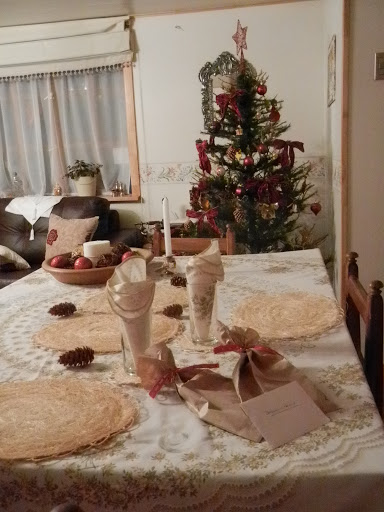
A few days before Christmas, we found ourselves at a bed and breakfast called Pire Mapu Cottage in Puerto Natales in Patagonia.  From the moment we walked in, we realized we were in an exceptional home with exceptional Chilean and British hosts.  We had found the place to stay for Christmas (which was not our original plan).  Fabiana and Bren made us feel as if we were long lost friends rather than two strangers intruding into their home.  They offered us their kitchen, fireplace and gorgeous dining room table as our setting for a salmon meal on Christmas Day.  Perhaps even more special, they gave us their company for our Christmas meal.  While we missed friends and family during the holiday, we found a very special home for the holiday.

Top image is of the dining room at the Pire Mapu Cottage in Puerto Natales, Chile; middle image is of the table we shared during our homestay on Taquile Island, Peru; and last image is of a simple hostel bed in Costa Rica.  

Posted in Punta Arenas, Chile

Monday, December 17, 2012

Refugees

The pain of a brutal past is obvious in Maruca's broken jawline, her twisted and battered nose, and in her slow ambling gait up the path in her current home within La Senta Verde near Coroico and the jungles of Bolivia.   She is one of 350 refugees who receive daily care at the facility.  Many arrived confused, ripped with violence from their homes, afraid of men, women, or children depending on past abuse or negligent treatment.  With good nutrition, daily medical treatment, and the gentle ministrations of more than a dozen volunteers from all over the world, the refugees have found a safe respite and new home.  Bolivia's governmental policies are such that is illegal for them to be returned to the jungles and plains of their original habitat.

Maruca is a spider monkey, and she and her fellow primates (including almost a dozen howler monkeys and dozens of incredibly cute and intelligent capuchin monkeys), two endangered Andean spectacled bears, over 100 reptiles, and birds of every shape and color, make up the community of animals rescued by Vicky and Marcelo Ossio.  The couple originally operated an ecolodge, mainly serving mountain bikers who road 69 kilometers from La Paz down "the world's most dangerous road" with the Gravity Biking Company.  About 8 years ago, they received their first capuchin monkey, Ciruelo.  Today they have the only licensed animal refuge in Bolivia and with the care of a wonderful veterinarian, Dr. Adriana Orellana, a great staff and many volunteers, they now receive dozens of animals a month.  Most are casualties of illegal pet trade or habitat loss due to ingress into National Parks and conversion of land to coca fields, activities encouraged by current governmental policies.

We were touched in deep and meaningful ways by the people and their animal refugees at La Senta Verde.  One young female, Wara, spends her days foiling human attempts to lock her out of buildings.  She is a rascal, but when Jess sat by her, she snuggled close, laying her head in Jess's lap.  Pimienta, another female spider monkey, recognized in Sally a kind and gentle soul as she climbed her for a long hug, a walk, and consolation as the young female spoke insistently into Sally's ear. Pimiento's sorrow was clear as was her need for reassurance.  The Amazonian parrots and macaws called out for attention as they mimicked both Spanish and English words, dog barks, cat meows, and sounds of video games.   All of the animals receive daily attention from a young and growing group of international volunteers.  Many soon to be volunteers first experience the refuge after an adrenaline-filled bike ride ending in lunch and a site tour.  Some cannot forget the sight of so many animals in such great need and come back for a week or two and stay for months or years.

Some people give of their time and others give money.  The needs of the refuge are significant.  Carrying capacity and beyond have been reached on this small 22 hectare site.  New enclosures, flight cages, quarantine areas, and clinics are being built for the ever growing group of animals in need.  Feeding the animals  and providing the medicines are costly as well.  It is a time of year we seek to give to others.  Instead of buying a materialistic object for someone this year, consider making a donation in that person's name to this worthy endeavor of human compassion for lost animal refugees.  You can donate to the refuge by PayPal or direct deposit.

La Senta Verde Pay Pal account -  lsv@sendaverde.com
Bank of America  TX2-563-01-01, Acct. Number 488036101948, Virginia Ossio
http://www.sendaverde.com/
Website with more donation information
http://adoptlsv.com/index.html

Posted in Bahia Blanca, Argentina

Monday, December 10, 2012

Bolivia: Land of Contrasts


Contrasts are all around us as we travel through South America.  We see it in the cities where the well to do go about their daily lives and pass by beggars in dire need of help.  We see it in the brightly colored clothing worn by the rural Andean women and the dark business suits worn by the city professionals.  We even see it in the dogs within each community.  Some are well cared for, dressed in coats, and have distinct collars while others are thin and ragged as they search for food among discarded garbage.  We also see it as we travel in the various buses from one place to another.  Some are comfortable, with reclining seats, movies, and meals.  Others show no movies, and the ride is so rough it is more a teeth chattering four-wheel drive excursion without suspension or shocks.

One of our most vivid experiences dealing with contrasts has been the tour of the Uyuni Salt Flats and its surrounding environments.  Landscapes here are so vast and different, they are difficult to describe.  One day, we are looking at a highly eroded, overgrazed valley with llamas, vicunas and goats around every turn.  Another day, we are amazed at the multiple colors of the mineral rich mountains where alluvial fans spread like glaciers from the mouths of drainages.  An additional day brings utter fascination as we try to understand the Mars-like scenes before us with steaming volcanoes, vast hills of red and huge, bizarre rocks that are remnants of volcanic eruptions, some not so long ago.

The salt flats themselves are an endless sea of white, where the natural geometric patterns of sodium chloride produce a cloud like crystaline quilt across the ground.  Small, distant islands within the salt flats provide a stark contrast to the sea of white, as giant cactuses rise up from the depths perched on the thin, rocky, volcanic soil in the midst.  The contrast between earth and sky fades as the flats produce mirages.  The cactus islands appear to float and the horizon disappears in a shimmer of merged land and sky.

Throughout this journey, we see so much that is new to us, much of which is incomprehensible.  The people, their food and culture, and the landscape are contrasts to what we have known for most of our lives.  In all of these contrasts, we find growth and enrichment and occasionally confusion or pain. What we seek in this journey is much like the mirages as anticipation becomes reality and each day shimmers and disappears.

Posted from La Paz, Bolivia

Sunday, November 25, 2012

17 Sheep


Seventeen sheep is what Celso needs to complete the forty-five required to marry Juana.  Taquile has complicated and beautiful traditions that are adhered to by the almost 2,000 inhabitants on this remote island in Lake Titicaca.  In 2005, the island was declared a world treasure by UNESCO for the beautiful textiles produced by both the men and women.  Men knit and women weave.  Both learn their trades as young children and much of their worth is determined by the detail and quality of the images they weave into caps, belts, shawls, and purses (worn only by the men).   The textiles tell stories of their own lives and their cultures.

Juana began weaving Celso a wedding belt when he came to live with her and her parents when he was 20

and she 19.  Each couple must live in each other's home for a year before the local elected headman might approve their marriage to be held in May.  The parents carefully watch for qualities in the possible couple that will suggest they will have a successful marriage.  There is no divorce so this is an important period of trial and testing.  Throughout it, the bride to be expresses her thoughts of her possible groom in her weavings of his belt.  He is also busy knitting a red hat (he must wear white if single) and a purse to hold the coca leaves married men exchange in greeting rather than handshakes or hugs. 

Despite an obvious successful match, a house, and a 6 year old, Juana and Celso remain unmarried, wearing clothing traditional to singles in their society.  They lack the 45 sheep this almost completely vegetarian society will feast on in May for a five day celebration.  Normally, the parents of both the bride and the groom provide the sheep; however, Celso is the 5th of 6 children and the sheep of his parents are gone.  He must
work in a society with little material wealth to earn the soles (Peruvian currency) for each sheep.  Without marriage, neither Celso's nor Juana's voices may be heard during the weekly communal assemblies and decisions of their island.


He had 28 and needed 17 sheep as our home stay with three other travelers from Ireland, Scotland, and  Czechoslovakia began.    We pooled our groups resources, bought weavings and knitted products, and donated money.  By the time we left, the family was three sheep nearer to a May wedding....

Pictures are from Taquile, Peru of Jess and Celso, Juana showing the wedding belt as Celso knits, and of Wilfredo, their 6 year old son.    Posted in La Paz, Bolivia