Thursday, March 14, 2013

One ring to rule them all

"Even the smallest person can change the course of the future" - Galadriel


OK, we admit it.  We are big fans of "Lord of the Rings" and "The Hobbit," and New Zealand is just the place to immerse ourselves in our love of these movies/books.  For much of the past decade, we gathered as a family with Jack each Christmas season to watch Aragon and Frodo realize their destinies. What we have found to be amazing, though, is the effect that not only these movies, but the legacy of their director, Peter Jackson, have had on this small country. 

Tourism is a vital part of the New Zealand economy.  Of course there are other industries such as agriculture, forestry, and fisheries and all of these in total make for a diverse and usually stable country.  During the last thirteen years, however, tourism has had a significant shot in the arm due, in large part, to the efforts of Sir Peter Jackson.  His trilogy, "Lord of Rings" became so popular that many of the movie locations are advertised and marketed as tourist attractions.  There are tour companies that exist only to provide tours of these sites for the visiting public.  Visitor information centers added personnel to handle the additional visitor traffic seeking anything they could visit concerning the trilogy, and we talked to employees who "had a job because of the trilogy."  Books have been published that detail (with GPS coordinates) site locations of the film and these books can be found in all bookstores and visitor centers across New Zealand.  Things are not slowing down for the movie buffs, as "The Hobbit" locations are now becoming just as popular.

Jackson, along with two other founders, has also located his Weta special effects business in his hometown of Wellington, on the North Island.  This studio/workshop/museum/office is an amazing wonderland that, until recently, was not accessible to the public due to patent concerns.  However, a portion of it is now open for guided tours, and topics such as false faces, armor and swords, stunt doubles, camera tricks, costumes, creation of/aging process of props, etc. are presented, explained and demonstrated----fascinating stuff for those of us who geek out over special effects and the wizards who create them.  Visitors come in droves to this small, inconspicuous building, and spend their vacation money touring this facility as well as for food and lodging in this quaint, bustling little community.

Probably the most surprising aspect of Jackson's influence came to us as a "must see" encouragement from other travelers and locals we met in New Zealand.  We were told more than once as we decided to meander through the wine country in the northern part of the South Island, that the vineyards and wine tasting were good, but the vintage avian heritage center in the same area was fabulous.  "World class" is the term brochures used to describe this museum that Peter Jackson has helped develop, but often we do not agree with the brochures, or with the people we talk to after we have actually visited a site.  However, we decided to see if Jackson's fingerprint could be identified here.  "Surprised" is not nearly a good enough word to explain our experience in this museum as we entered a dark and magical journey in the skies over Europe a century ago.  Jackson, who apparently is a World War I aviation buff, and his Weta studio, put together a fascinating journey beginning with early aviation through World War I with life size planes and figures in dioramas that are as detailed as real life.  There are biographies of many of the pilots, from Eddie Rickenbacker to Baron von Richtoffen. We were mesmerized and amazed as we stepped back in time and lived some of the moments depicted in the dioramas.  It was a stunning and unforgettable experience. The greater unforgettable experience will be a growing understanding of how one person supported by a team of creative geniuses with vision and passion can change the world.  

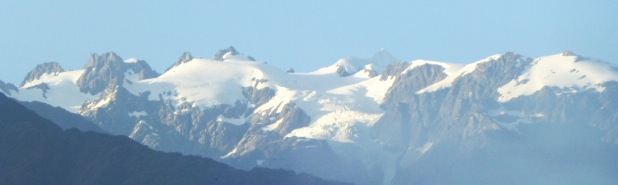
Images are of Frodo's famous hairy feet at Weta Cave, one of dozens of displays at the Avian Heritage Center in Blenhein, and the "Beacons of Gondor" film setting at the Franz Joseph Glacier.

Posted in Moeraki, New Zealand

Monday, March 4, 2013

Invaders

A walk through the California Redwoods puts everything in perspective, gazing at giants that began life as tiny seeds searching for light in a dense forest.  The smell of natural decay in this forest is one of life, rather than death, as the eternal cycle of life continues as it has for eons.  What's wrong with this picture is that we were not in Northern California, rather a few kilometers outside of Rotorua, New Zealand.

One of the strongest patterns we are seeing in our eight months of travel is the stark, all encompassing influence of Homo sapiens.  Humans have, through time, "introduced" to native landscapes many of their favorite aspects of home.  Most times, the introductions have been deliberate attempts to convert a native landscape into something more profitable or familiar; however, many of the introductions of exotics have been accidental.  Whether deliberate or accidental, these introduced species are the single most significant factor to date behind the global extinction and endangerment of native species whether they be one third of all of the extant plant species in Chile, common myna birds on the Cook Islands, or possums in New Zealand.  The local ecosystems and endemic species simply have no tools to resist the onslaught.  For example, myriad flightless birds evolved in the island country of New Zealand in the complete absence of mammalian predators.  Today, rats, cats and possums dominate the landscape necessitating identified zones of poison where air raids rain toxic pellets on the land and bounties are offered on possums to give local species a chance to recover.

While the transformation of the natural world is alarming, we have contemplated the level of cultural contamination as well.  Every country we have been to has a similar story of losing some part of its identity, often with a fight over resources or religion at its center.  Invaders bring disease, war, forced conversion, and extinction to people and cultures that had evolved across millenniums on the land.  Today, that cultural invasion appears to be one of mega corporations, fast food, and pop culture as we find our Monsanto, McDonald's, and music in every region and zone we have traveled.

What is gained from such efforts can be a common appreciation, sense of familiarity, and basic comfort with the known and homogeneous world.  What is lost are the evolutionary branches of organism and cultural diversity that we celebrate in our nature programs and festivals even as they dissolve and disappear. At the beginning, invaders are generally welcomed.  It is often not until all that was special about a place disappears that the invaders are recognized for what they were.

Images are of a poisoned possum, bounty sign on a New Zealand window, and a ubiquitous McDonalds advertisement in South America.  Posted from Franz Joseph Glacier, South Island, New Zealand

Friday, February 8, 2013

It's so easy


People talk about how they feel after traveling abroad for awhile so we were curious as to how we would feel during our few days in LA prior to renewing our travels in New Zealand, Australia, Indonesia and Malaysia.  We have been back only two days but have one dominating thought:  It's so easy.

While traveling for the last few months in South America, we had incredible experiences with people, nature, and domestic animals.  Each day was an adventure and the vast majority were rewarding, stimulating, educational, and some, even mind-boggling.  However, each day was also a struggle.  Every day required us to figure out the basic necessities of our lives.  Where would we sleep, how could we move from point A to point B, how would we get drinkable water, what could we safely eat, and how could we find public toilets?  Those basics of life were being executed in second and third world nations in a language that was foreign to us and in societies that were novel.   Some days were more complicated as we sought medical assistance or tried to communicate with financial institutions in the United States.  Getting money was much harder after we were robbed of the easiest tools for accessing our resources.  Transportation was challenging and often fraught with greater risks.

In LA, we slipped into a rental car (prearranged by bidding on Priceline) at a daily rate one-fifth of what we paid the two times we rented in Chile.  While our phone was shut off, it still provided GPS map service given the coverage in Southern California.  We were able to see a podiatrist in the morning and get a same day dental appointment in the afternoon while driving safely through, for the most part, paved, well-marked streets.  Our beloved Tito's Tacos provided some of the safest, quickest, and most delicious food we had eaten this month, and Trader Joe's supplied our healthy dinner.  Our best friend Lisa's house and our cousin Michele's home were warm, secure, and welcoming with a refrigerator full of good food.  There was excellent coffee for breakfast rather than the freeze dried Nescafe beloved by people to the south.  And everywhere we went, there were toilets with toilet paper provided (a rarity in South America) and the ability to flush it into a system terminating in a wastewater treatment plant rather than turning a local river a frothy, chocolate brown.  As we stopped briefly at a CVS pharmacy, the array of choices for our needs was truly staggering as well as was the quality and, overall, lower prices. 


It's easy here and we did not understand the difference until we sold everything, put on packs, and chose a distant land for our destination.  We cannot say the experience has made us more grateful as each day of our lives we recognized we were two of the luckiest people to have ever walked the planet.  Perhaps it just makes us more certain of the truth behind that statement.

We are curious as to how we will feel in both New Zealand and Australia and suspect it will feel much the same as being in the United States given a common language and first-world infrastructure.  Indonesia, Malaysia and Southeast Asia lay before us as well, and we know that those cultures have much to teach us about ourselves and others.  It is almost time to put on the freshly washed clothes and packs and begin again.....

Posted in Irvine, CA.  Pictures are of our cousin Michelle and Sally at In-N-Out Burger and Sally getting a much needed haircut!

Monday, February 4, 2013

Kids Again

As we head out of Latin America, we decided to finish this part of our "hundred stories" with two of our favorite events.  Both were unexpected in the power they had to tap into our deepest childhood memories.


Outer space


My dream as I was growing up was to become an astronomer.  At the age of seven, I was totally captivated when Sputnik was launched.  Space captured my imagination, and I spent many hours gazing skyward, identifying constellations and looking for planets.  As the space race began, I became especially interested in the Gemini and Apollo projects and kept a thick scrapbook of newspaper clippings concerning each mission.

As happens many times in life, as I grew older, I followed many different paths and left my dreams of astronomy behind.  Though still perking my interest when major stories concerning the skies, heavenly bodies, and space craft were broadcast, I no longer pursued my dream with the energy I had displayed in my earlier years.  


Dreams have a way of being realized sometimes in the future.  Last night I had the opportunity to realize a part of my dreams in a major way when I was able to stand, awestruck, in the middle of a giant observatory and watch as it "woke up" to the night sky.  My guide in this miraculous opportunity was a young astronomer who is just now beginning his lifetime journey investigating the vast universe through the lens of the incredible scope housed in this structure.  

As I stood in silent wonder, the walls of the observatory began to rotate, giving me a sense of vertigo.  The walls opened and as I looked up to the top of the dome, it, too began to slowly expose the scope to the sky as the center piece receded back onto itself.  The huge blue supporting arms reached high and, as the surreal experience continued, the entire structure began to tip toward me, slowly revealing the majestic mirror, looking like a sea of quivering, silver mercury encased in a huge blue dish.  As the blackness of night closed in around the observatory, we adjourned to the grounds outside the awesome structure, pausing to watch as more and more stars took their age old places in the heavens.  Then, within a predesigned plan, a laser beam shot an eerie,  straight orange line from the scope far, far into space.  Against the blackness of the night time sky, it was an incredible sight.

As we left the observatory late that night, I was humbled and filed with wonder as I again was a child of seven gazing into the vastness of the heavens.....  

Inner Planet


"I had thought they would be gone" was the answer to why I was crying.  I couldn't figure it out.  The Chilean captain had announced that blue whales were off the port side of the ferry and as I rushed out to see them, I caught my first glimpse of the biggest mammal that has ever existed on the planet.  As I watched the four individuals dive and move around the ship, I started to cry.  

Deep emotion is often connected to deep, long un-accessed memory.  As I searched for the root of my tears, I remembered an eight-year-old Jess doing her "show and tell" presentation on "endangered species," a new concept after the 1973 act signed by Nixon became law.  I had chosen "Blue Whales" and pasted pictures of them and sea life into a shoebox diorama.  My report to my third grade class was about how we had overhunted them to probable extinction and less than 1% of the intelligent giant denizens of the deepest ocean were left.....yet the hunting continued.

At the tender age of eight, I mourned their loss from my planet.  I thought they were gone.  Yet, there they were before me on a cold day near the coast of Chiloe Island.  A few thousand exist, persisting and surviving.  Seeing them wild and free made me cry tears of deep joy and gave me hope for other species, including our own.

Posted from Santiago, Chile

Sunday, January 20, 2013

Robbed

We had become complacent.  When we first arrived in Latin America, we were constantly on the alert for anyone trying to take things from us.  We read about taxi cabs, kidnappings, con artists and corrupt officials.  We minimized risk by keeping credit cards well hidden, only a little cash in our wallets, and our passports on us at all times.  We never put a bag on the rack above us on a bus, and kept tight hold of our cameras and devices, rarely taking them out unless we felt safe.  But with time, and the almost constant kindness of strangers, we became complacent.  As we began this journey described in our first blog posting, our goals were to seek to learn with humility, grow together, and, where possible, give with grace.

No one likes to be robbed.  We were hustled by a team at a crowded bus station in Puerto Montt.  They surrounded us, pushing, smiling reassuringly, offering to help us hand our packs to the bus loader.  The bus employee stopped loading baggage with cold suspicion telling us to check our possessions and pockets as two of the men moved rapidly toward an exit and a third women faded away into the crowd.  They took with them not only Sally's wallet but some of our innocence and much of our joy that day.


Yet, as we boarded the bus with less cash and no credit cards, we processed what it meant to learn with humility.  We knew some of the lessons would be harder than others, and we pray that none come from physical harm.  We were well "schooled" yesterday, and we reviewed what happened as well as what can be done in the future.  Neither of us wants to look at strangers with fear or suspicion as we move through a world rich with the variety of humanity found everywhere.  Most have helped us and these three individuals mainly harmed our pride and increased our challenge of using the resources we need to continue the time remaining in our South America adventure. 

We learned a lot yesterday and, as we work with banks and credit card companies, we learned more today.  As anyone knows who has had credit and ATM cards stolen, the degree to which they are used in ways that are not transparent becomes painfully clear as many daily transactions, activities, and actions are blocked or refused.  In talking to others in our hostel, we have also been shocked by the frequency in which they, too, have been victimized.  Because of this, they have been sources of good advice as we seek police reports and ways to put our financial life back together.


We had become complacent.  We are wiser for the experience yesterday and thoughtful about what it really means to learn with humility and to give with grace. 


Posted in Valdivia, Chile


Images of us on a bus before we were robbed, Jess at an ATM in Valdivia, and Sally with her friend Pirate proving that not all encounters go badly! 

Friday, January 18, 2013

You know you have been traveling a long time when...

  1. You hear that the temperature in Gunnison is -33 F and you have to translate it to Celsius.
  2. The concept of "new" clothes does not mean a shopping spree, rather a trip to the laundry.
  3. You habitually hoard toilet paper.
  4. You rate restaurants by their wifi strength rather than the quality of their food.
  5. "Ready to go" means your backpack is closed.
  6. Regular body functions are a highlight of the week.
  7. You can recite your passport number but have forgotten your cell phone number.
  8. You barter with each other for used ziplocks.
  9. Your skin lotion must be at least SPF 50.
  10. The only unacceptable bed is one with bedbugs.

Posted in Puerto Varas, Chile

Sunday, January 6, 2013

What do we like?

As we approach the end of the first third of our journey, we find ourselves processing the answer to the question "What do we like?"   We have been to urban cities of millions and towns of dozens.  We have perused museums, churches, and historical sites treading in the footsteps of prehistoric and historic figures.  We have experienced Ejectivo buses with pillows, blankets and reclining seats that convert to beds and chicken buses where sheep share our seats.  We have slept on thin bedding over hard, unyielding salt blocks, in hostels without electricity or water and in resorts where our backpacks marked us as intruders.

We have hiked in "tourist" groups following guides up and down seaside trails and have explored hidden remnants of ancient forests with local biologists.  We have meandered by ourselves along old animal trails and long abandoned roads losing ourselves to the quiet voice of nature.  We have toured by canoe, jeep, ferry, bus, and on foot.  We have gazed at incredible and diverse panoramic landscapes covered by sea, ice, salt, lava, and forests of every shape and kind.  

We have been cold, hot, wet and dry... sometimes in the same hour.  

While each experience has its values, its impacts and its lessons, we find we consistently gravitate toward certain types.  We prefer the countryside to the cities.  It is not the quality of the place we love at bedtime, rather, the feeling of being welcome.  While occasional experts are valued for their knowledge, the joy of self-discovery is generally much more satisfying.  We would rather fish by ourselves along an undiscovered stream than be "directed and assisted" on a charter.  We like the lonely hikes where the wildlife are our companions.  Sally does not like it too cold nor Jess too hot.  We both prefer home cooked to restaurant meals.


With reflection, we prefer the types of experiences we have long loved in the Gunnison Valley (or at least those in spring, summer, and fall!).  While the novelties of culture, cuisine, people and place are of enormous value to us currently, we reflect on the wisdom of Dorothy Gale when she stated "There's no place like home."


Glacier in Bernardo O´Higgins National Park, Chile; cooking lamb and other meat at an asado or BBQ at an Estancia in Chile; floating toward the Beagle Channel in Tierra del Fuego NP, Argentina.

Posted from Punta Arenas, Chile