Sunday, July 28, 2013

We're coming home!

The last thing we anticipated over a year ago at the start of our journey is that by the thinnest margin of one vote, a Supreme Court decision would bring us home.   Our life is similar to so many of our friends because we met almost 25 years ago, knew within a year that we had found the person we wanted to live with "till death do us part", and made a personal commitment to a lifetime partnership.

Unfortunately, our commitment has never been recognized by the Federal Government as valid so we were unable to get Jess insurance, tax, or annuity benefits through Sally's federal job.  These would have been financially helpful in the past, but are even more important now as we travel.  If Jess was a man, we would have saved almost $4,000 dollars in health insurance last year, $6,800 this coming year and almost $70,000 over the next decade, and she would have received better coverage with lower deductibles.  If male, Jess would also receive half of Sally's annuity and all of her social security survivor benefits if Sally passed first.  Our current life expectancy calculations result in projected benefits for Social Security being worth an additional $159,264 and annuity benefits being $62,784.

None of those tangible economic benefits were possible while the 1996 Defense of Marriage Act (DOMA) defined, for the purpose of thousands of federal laws and rules, that marriage was only legitimate between a man and a woman.  DOMA barred same-sex married couples from being recognized as "spouses" for the purpose of receiving federal benefits such as health insurance, social security survivors' benefits, inheritances, annuities, and the filing of joint tax returns.

Things changed dramatically on June 26, 2013, when the Supreme Court, in a 5-4 decision, struck down parts of DOMA as unconstitutional, agreeing with the president who said "This was discrimination enshrined in law. It treated loving, committed gay and lesbian couples as a separate and lesser class of people."  We don't perceive that we are particularly political or extreme in our views; however, it does sadden us and grind us down a bit when we are not allowed the same benefits because of the simple choice of who, and what gender, we love.  We have always been well treated by our friends, colleagues, families and employers, but have been prohibited some tangible benefits at every stage of our lives routinely provided to our heterosexual friends.

For us, it is a simple financial decision to fly to California, stand with our witnesses who have supported us for over two decades, and tie the knot.  It is also an incredibly symbolic decision that slowly, in our country, we will be treated with more equality than when we left a year ago.  Same-sex marriage is allowed in 13 states and prohibited in 29.  At least now, if married in one of those 13 states, we can receive the same federal benefits as our heterosexual friends.  So we are coming home.  And getting married.

We hope to see family and friends for the few short weeks we plan on being home before we head to Nepal.  We miss you, and we will have much to celebrate with you!

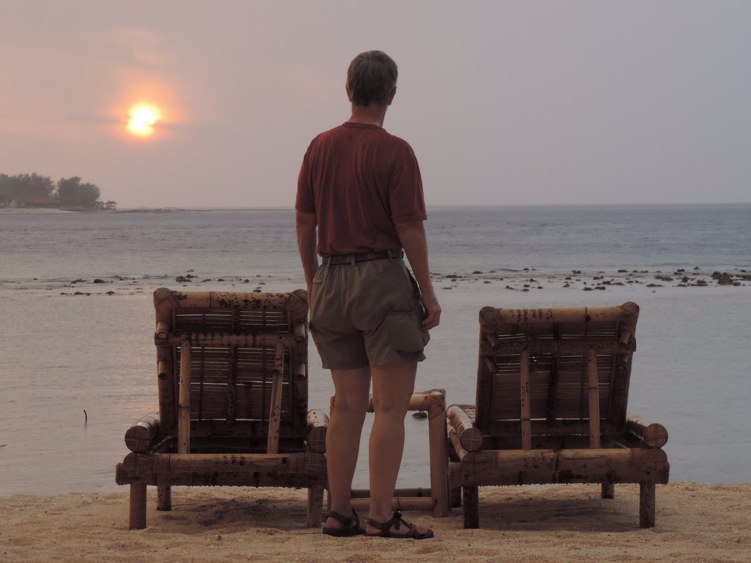
Images are of a much younger couple on an ATV doing research in 1990 in the Gunnison Basin, a Galapagos class trip in 2004, and a quiet moment in Bolivia last year on the salt flats.  Posted in Yogjakarta, Java, Indonesia.

Friday, July 26, 2013

Here be Dragons


Komodo Dragons are fierce, dangerous, 300 pound predators that frequently attack not only water buffaloes and local deer, but people.  Their red saliva can be seen along trails where they regurgitate undigested pieces of the previous week's meal.  The creatures are faster than one would think, and will even attempt to chase a fleeing person up a tree.  You can imagine our friends' surprise when we posted on Facebook that we had finally seen them and found the journey to them much more dangerous than the dragons.

We had come back to Indonesia after our previous April visit, in part, to find Komodo Dragons in the wild.  We also wanted to see more of the 17,000+ islands than what Bali alone could offer.  As we hopped down the island chain in eastern Indonesia, we were well rewarded by the incredibly diverse cultures we visited.  One island would have predominately Hindu natives, the next Muslim, and the third Catholic, all of whom also believe in magic.  Most of our travel was the moderately risky type we have described in previous posts, until we decided to take a two night "cruise" to bring us the last miles to the dragons.

For us, it was a pricey choice.  It cost $300 each for a "private" cabin and $200 for no cabin and a mat on the deck among several other people.  This is in a place that nice accommodations can be obtained for $30 a night and $5 buys a meal fit for a king.  We asked about the cabins, found one was available, and ascertained there was secure room storage for our bags, two beds (no bathroom), and a fan.  We decided to go "deluxe" and get a cabin.  The Perama Company representatives had been accurate.......there were two beds, although the slightly wider bottom consisted of a mattress on the floor and required a person to roll into it as the top bunk was claustrophobically close.  The "secure storage" was a 6 or 8 inch strip of floor between the mattress and the wall, and the fan was tiny and offered little relief in the tropics even for the top bunk where it was pointed.  All of that would have been workable except for a few additional surprises.  The first is that while Perama had been correct in telling us there were two bunks, they neglected to mention they had sold one to our roommate, a sweet girl from France.  When we realized that three of us needed to cram into a room built for two hobbit-sized beings, we talked to the company rep and guide before we left the first night.  They assured us that one of us could have a mat on the deck if the room was too packed.

Gamely, Jess prepared for her first night in the hot, dark, stifling space and rolled toward the wall only to find that the mattress was soaking wet.  After a few minutes something crawled over her.  She made the mistake of asking Sally to get a headlamp.  Imagine our "dismay" when we discovered a myriad of spider webs and cockroaches!  One giant roach was twitching its antennae and staring, appraising us carefully.  After the third heavy strike with a sandal it was stunned, not dead.  We gave it a burial at sea.  We can take a lot, but this space was too much for either of us, even after we fumigated it with our roommate's insecticide.  (We were to find that several people travel with insecticide in Indonesia and they thought we were crazy to travel without.)  Jess went in search of our guide to find out that the ship designed for 30-40 people had an all time high of 52,  and despite assuring us less than two hours earlier there was room on the deck, they stated there was none.

A fairly frustrated Jess then elected to sleep in the open air garbage bay at the back of the boat near the motors, preferring the smell of rotten fish and the sticky goo of spilled beer and pop to the comforts of the "deluxe cabin".  The benevolent Company did supply her with a thin mat on which to sleep..... Her new "bedroom" was between those sleeping on the upper deck and the bathrooms on the lower so she had lots of visitors stumbling by.  Sally "slept" on the the very outside edge of the lower mattress and our roommate on the top bunk.

The 52 passengers and 10 crew turned out to be about 20 more than the number of available life jackets.  While that may not matter much in most countries, in Indonesia, boats disappear frequently. The currents around Komodo Island are especially dangerous and a Perama Company craft had shipwrecked there two years ago.  On the second night, as we approached the notorious Komodo waters, our roommate woke us both up, afraid.  The seas were rough and we had just hit something in the water.  We tried to alleviate her fears by promising we would stick with her and getting headlamps and the two life jackets in our three person cabin ready.  One was virtually unusable and took 20 minutes with a Swiss Army knife to get it to the point where one of us might be able to wear it.  So much for reassuring our roommate.  Eventually dawn did come.  However, as we cued up for breakfast, the strong currents would hit the ship so hard, that 52 people would run to the "high side" on orders from the crew trying to help us avert disaster.  We have done similar maneuvers on a white water raft, but were surprised to be doing so on the cruise ship as it tilted toward the sea.

Ahhh... Indonesia.  Here be dragons.  Here, each mile traveled often has to be earned, so this was the journey to help us appreciate the destination.  The Komodo Dragons were fearsome and majestic. The beaches on the national park were pink and the coral reefs the healthiest we have encountered.  The people on the boat were fun and well traveled.  We would come back again... Just not on one of these boats!

Images are
of our new favorite land reptile; of our "cruise ship"; and of Sally in the breakfast line about 5 seconds before we needed to "high side"!  Posted in Bali, Indonesia.

Tuesday, July 23, 2013

Carpe Diem "Sieze the Day"


Traveling with a fairly severe disease is a bit of a challenge occasionally.  Rheumatoid Arthritis, an auto immune disease with which I was diagnosed about four years ago, is a disease for which there is no cure, and it can result in unbelievably painful, disfigured, and swollen joints.  It can worsen, even though there are a myriad of drugs, some with severe side-effects, for controlling the symptoms.  For some victims, drugs do not work, and they are relegated to painfully twisted joints and/or life in a wheelchair.  I have seen patients at a clinic with limbs (fingers, hands, knees) so bent and deformed that they cannot move let alone heft a pack down a trail.

My RA is currently fairly well under control with a somewhat mild drug.  The drug causes me to be pretty susceptible to sunburn, have an iron deficiency, and reduces calcium intake, but most other side effects are minimized because of the low dosage I am taking.  Other, more potent drugs, would have more severe side effects, such as possible liver problems, sight problems and intestinal problems. Along with the prescription I take, I must supplement it with calcium and vitamin D3 and be much more cognizant that a fall is likely to lead to bones breaking.  Occasionally, a few prescription steroid pills or an Aleve are necessary to calm my occasional, intensely painful, "flare-ups".  To coin a phrase from our friend, John Hausdoerffer, I am a "walking pharmacy," and carrying a couple years' worth of prescriptions around on my back is not one of the aspects of traveling I enjoy.

But traveling with a disease like this has been interesting.  There are days my shoulder and/or wrist are so painful I cannot move them.  Other days, the pain is "in the background" all day. Still other days, I have no pain at all.  Most days, the pain is minor and I go about the "business" of hiking, kayaking, snorkeling, etc. with no problems.  Occasionally, I must rest or take it easy for a couple of days.  The pain I experience has led to a major loss of strength in both my hands and especially my left arm.  The pain in my hips and legs has resulted in lower body stiffness and a real detriment to my balance because I cannot make my legs and feet move fast enough to compensate for the movement of my upper body.  Traveling in countries where sidewalks, if present, are broken, cracked and full of sewage holes and bathrooms are nothing but a place to squat is challenging given my balance issues.  The common "handicap accessible" infrastructure of the States is a "foreign" concept in most of the world and makes me appreciate the standards for such things in the US.

Each flare-up brings forth the inevitable thought of whether we can continue our great adventure. One of the reasons Jess and I decided to take this journey at this point in our lives and her career is because we did not know how my disease would progress.  So far, it has not affected me much.  If it eventually does, I will be tied very tightly to somewhere that I can be regularly tested and monitored and can receive medicine that would not "travel" well!  For us, it is important to grow and learn from the rest of the world.  To miss this opportunity is not an option to us.  We feel it is important to see and do while we still can, and we have not been disappointed.  What will we do if my disease worsens (or, for that matter, if Jess gets really sick)?

As they say, we will cross that bridge if we come to it.  Until then, we wake up each day ready for our new adventure, looking forward to meeting those we don't know yet, ready to be overwhelmed and humbled.  Carpe Diem.

Sally looking through part of her "pharmacy" on a boat near Maumere, Flores; Staving off the Komodo Dragons on Rica Island, Indonesia; A quiet moment of reflection at LaBuan Bajo, Flores, Indonesia.  Posted in Bali, Indonesia.

Thursday, July 11, 2013

Fear and Fascination


The first time we heard the call for prayer from a local mosque was in Kuching, Malaysia.  The Arabic chanting was exotic, beautiful, and new to our middle-class, Christian ears.  Then came the images of fear......two towers burning, falling to the ground in plumes of dust and ashes.

There are many times during our trip that we have felt these mixtures of emotion----fear and fascination.   One such moment came as we snorkeled over our first great coral cliff far from the safety of land on the nearby island in Indonesia.  We hung in the water, half over the multicolored fish just 30 feet below staring into the dark, deep abyss over the cliff's edge where a lone shark patrolled.

Another time was when we realized that the clouds on a nearby volcano in Costa Rica were smoke and steam, a sight which was to repeat itself on other islands and continents with active volcanoes.  We were used to the "whooff" sound snow makes before the avalanche starts or the shaking of the land during earthquakes, but active volcanoes were a novel and titillating experience.

We were well aware of the vast number of deadly and poisonous invertebrates and vertebrates as we crossed through Australia.  Whether brushing through a spider web, gazing at the mildly poisonous spine on the duck-billed platypus, or watching out for one of the many deadly snakes, we knew there were risks in our daytime and night walks.

But the fear of a religious people who dominate much of the world we now travel surprised us.  Our first experience with somewhat conservative Islamic beliefs led us to quickly change our dress and hesitate to walk at night in the towns within the state of Sabah, Borneo in Malaysia.  We loved the food, peeked curiously at the tight and constraining costumes of the women, but felt as foreign as we had anywhere in the world.

As we listen each night to calls for prayers and walk past some of the over 100 mosques on the small island of Lombok during Ramadan, we are curious.  We overcome the images of the towers and engage locals in discussions of their faith as we have all over the world while visiting cathedrals and temples.  Yet, so far, we have not entered a mosque.  We know we will soon.   The actions of extremists in any religion should not have a profound impact on how we engage each other.  There are over two billion followers of the teachings of Islam and more than 60% are found in South Asia, a place we have come to love and which continues to fascinate us.  We just have to replace the images of those towers with new images of people and beautiful places as we travel through Muslim dominated countries.

But for now, we are headed for Komodo Dragons.  These 10 feet long, 300 pound venomous beasts will eat anything, even water buffaloes and the occasional person.  We can't wait to see them in the wild.

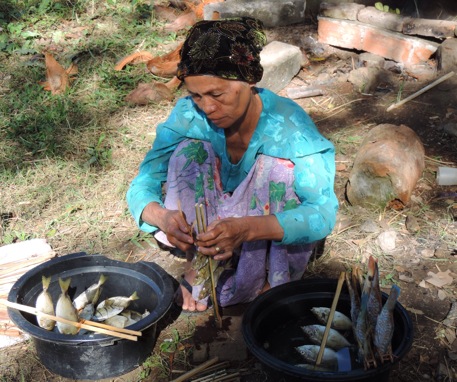
Images are of a woman selling smoked fish in Kuta, Indonesia, the Arenal Volcano in Costa Rica, and a Muslim Sasak massage specialist in Lombok, Indonesia.  Posted in Lombok. Indonesia.

Tuesday, July 2, 2013

May I Be Excused?

  
A common question we both remember from our childhood at the dinner table was "May I be excused?"   If there was much on your plate, the answer was typically "no," as parents raised during the depression knew the importance of food in a way that our generation had not experienced.  This nightly reality led to a few "adaptive" behaviors.  For example, Sally became expert at hiding peas and Jess's family dog often lay close to her seat.  The reality of needing to finish every bite did not promote experimentation, despite both of our mothers insisting we try "just a little bit" of everything on the table.

Despite the programming to be cautiously risk averse to new foods, we have loved the opportunity to try new foods as we have traveled this year.  Of course, not every attempt has resulted in new favorites, but all have been interesting and our parents are no longer around to make us finish our plates if we choose poorly.

Overall, we have, much to our chagrin, loved bakeries. We have found tasty treats whether savory or sweet in bakeries all over the world.  We enjoyed them so much that after two months on the road in Alaska and Canada, we weighed ourselves and realized the need for a lot more moderation and hiking.  While we have had some incredible treats in Canada, New Zealand and much of South America, it will be the Filipino bakeries that we will best remember.  Whether simple or fancy, at a bus station or on a promenade, the treats have been delectable.  For all those who are adding ideas to their bucket lists, we contend that we did not truly understand gastric bliss until the meringue cashew filling of a perfect silvana melted in our mouths.

Not all new foraging adventures have ended in moans of culinary rapture.  We have come to recognize that many sea creatures are better left in the ocean than served on our plates.  We have dined on jellyfish, abalone, conch, octopus, squid, and sea cucumbers and found that generally (but not always), the textures overcome the taste.  Yet, raw sea urchin gonads really were tasty, and they mixed nicely with spicy vinegar rice.  While satay sticks are a passion for Jess, even she gave up on the third attempt in Malaysia where the typical satay is chicken tails.  Charred tough skin stretched over globules of yellow fat and soft bones is obviously not for everyone, regardless of the sauces added to them.  Whitebait is a delicacy all over New Zealand.  Yet, when we gazed into the small black eyes of the tiny fish we were to eat whole in our fritter, we paused, blinked, and turned away.

As we prepare to venture deeper into Indonesia, Thailand, Cambodia and Nepal, we know we will continue to pursue our love of sampling local cuisines.  Just don't tell any parents if we leave something on our plates!

Images are of Jess in yet another Filipino bakery; sea cucumber delight; and a white bait fritter from New Zealand.  Posted in Cebu, Philippines

Wednesday, June 26, 2013

The Gringo Trail


One of the best pieces of advice for our journey came from our friend, Phil Crossley.  Unfortunately, we have found it very difficult to follow.  Phil urged us to get off "The Gringo Trail" whenever possible, to explore the corners of the earth that see few tourists and which just might be representative of the people and place in that area.


Such is challenging for two novice world travelers. These are the places with little or infrequent public transport where walking and motorbikes may be the norms but buses and taxis are rare or non-existent.  People are less likely to speak any English in these corners of the world.  Food may be less likely to be prepared in a hygienic way that helps keep us moving fluidly rather than moving fluids.

The Gringo Trail also tends to exist because there are terrific sights and sites to behold.  Think Grand Canyon, Rome's Coliseum, Swiss Alps, the Great Wall of China, etc.  So for much of our first year, we have tread firmly in the footsteps of others on the often slightly polluted, always full, and clearly described tourist tracks in Lonely Planet.  We have tried to ask locals for ideas of things to see that most tourists rush by, but such has been limited to a few hours in a few places...until recently...

In the last couple of weeks, we have begun to find special sites and sights off the beaten track.  On the small island of Bohol in the Philippines, we walked a road for miles where locals
emerged to grin and wave, many asking us "where you going?"  We have taken the time to listen to a local children's choir practice to find to our astonishment it was the world famous, internationally traveled, Loboc's Children Choir.  We stayed a few extra nights to catch the performance of the Loboc Youth Ambassador Band.  Both groups are the inspired vision of music loving locals who mortgaged their business and sacrificed their time to give these children a future.  On Siquijor, we are practicing our motorbike skills (Jess for the first time) and touring smaller, only locally known roads.  We have not seen another non-Filipino tourist in a week.
And soon, we plan on returning to Indonesia.  We loved Bali. However, 80% of Indonesian bound foreign tourists visit only Bali.  There are 17,507 other islands in the fourth most populous country on earth.  These are the islands that helped Alfred Russell Wallace co-develop the theory of evolution as his contemporary colleague, Darwin, pondered his findings from the Galapagos archipelago.  They are the islands where Komodo Dragons roam, living "Hobbits" exist, and the birthplace of spices gracing our kitchen counters.  And...places far from the normal tourist trail.


Images are of our first motorbike ride on Siquijor Island, three young ladies from the Loboc Children's Choir, and typical river transport in the Philippines.  Posted in Larena, Siquijor Island, Philippines

Sunday, June 16, 2013

Hon, My Hat is Mildewing

One morning this week Jess exclaimed "My hat is mildewing!" as she looked in dismay at her relatively new hat purchased a month ago in Malaysia.  While many things differ between our native Gunnison, Colorado and places during our travels abroad, humidity is one of the most significant.  In Gunnison, new arrivals generally have a nosebleed before their first night has passed given the arid and often frigid environment.  Ever since we were in Northern Australia, we have endured a swampy, hot environment in which clothes (and people) never fully dry out.  Add to the mix our penchant to hang out on the beach in these environments, and our non-synthetic clothes begin to rot!

One such place has been the Philippines.  The Philippines are comprised of over 7,000 islands with a varied people speaking over 70 languages.  The primarily Catholic Southeastern Asian country had an interesting mix of first Spanish then US rule during the past four centuries and the smiling, welcoming, resilient people have elements of those as well as other Asian cultures in their everyday life.

As we have described in earlier posts about other places, our time in the Philippines is a series of contrasting experiences.  We may have days in which we are lounging in a resort environment, drinking fruity, happy-hour concoctions and nursing sunburns from too many hours of glorious, snorkeling adventures.  Then there are days like yesterday....

We began the day as we had the previous ones on Malapascua Island without Internet as a storm had knocked it out almost a week earlier.  We walked across the island following young men gracious enough to carry old ladies' backpacks to a small port.  Really, it was a place on the beach where a half dozen sea captains of local bangkas designed to ferry passengers across the sea lounged about waiting for passengers.  Our captain squeezed two dozen of us onto the wood platforms of his trusty banga and set off for the distant shore just under an hour away.  Nowhere were the common sights of fluorescent life jackets on this boat, perhaps attesting to the unique skills of the teen- and preteen- age boys assisting our captain by pumping out water almost, but not quite, as fast as it entered the engine compartment.  The captain and his crew chain-smoked their way across the Philippine Sea with indifference to either the gasoline fumes or hastily tossed propane tanks piled behind them.  Across from us we watched as two young girls picked lice out of each other's hair, a frequent sight on the island with two thousand residents but no doctor or real health care.  A young tourist joined in the grooming, and as they all flung their invertebrate finds into the air we could only hope we were not directly downwind in our nearby seats.  We arrived on land to clamber aboard a local, non-air-conditioned "chicken bus" as we like to call the busses on different continents that transport people and other assorted goods and farm animals.  These busses stop frequently as drivers compete to see which can get the most people squeezed into a small, humid, hot space.  Sharing seats with several others is common.  As we eyed the girls from our boat ride in their nearby seats, we could not help but check the heads of the variety of children placed adjacent or within our laps.  We almost burst out laughing when we heard from the back of the bus a rooster crowing as dusk approached.

Around seven hours after we set out, we arrived in Cebu City to air conditioning, hot water and a nearby mall.  Somehow the easy access to electricity and water was disappointing after days of rationing each and paying for each kilowatt used after the first one at our lodging on Malapascua. Health care and resources are challenging to acquire on most of the inhabited islands in the Philippines and it is so easy to forget that when we arrive at a place where they are at our fingertips.

Whether we are wet or dry, it is the incredible contrasts of our daily lives that educate us on this global journey.  While we could pay more and travel in relative luxury, we often choose the more local route for the experiences and conversations it affords us.  Our stated goal is to learn with humility (and give with grace) and such is hard to do from a fancy, air-conditioned, tourist transport.

Images are from the Philippines and include our most recent "porch" on Malapascua Island, a typical bangka ferry, and the luxurious Sea Dream resort in Dauin, Negros Island.

Posted in Tagbiliran, Bohol Island, Philippines