Wednesday, May 8, 2013

Would You Swap?

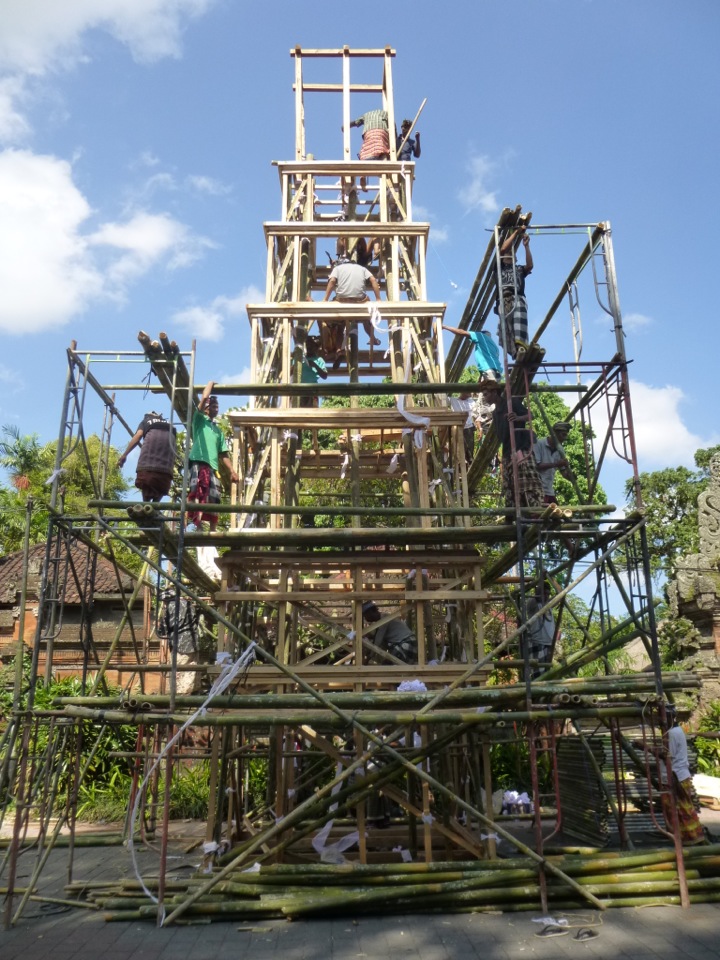
The structure was slowly taking shape as the workers used leaf fiber to secure the bamboo and wood planking to the skeleton already in place.  We stood on the rough sidewalk and watched and were approached by a young man about a taxi ride.  We declined the offer, but struck up a conversation with him about the structure across the narrow street.  Wayan (yes, one of the many) explained that the structure was a cremation tower being built for a member of the royal family.  While no one knew exactly which member of the Royal family had died, the tower construction was the responsibility of a group of families in the town of Ubud, in Bali, Indonesia.  The body will be brought to the tower and placed on top.  The tower will then be carried through town in a procession ceremony, and finally the tower will be set on fire.  As we discussed the cremation ceremony, politics and life with Wayan, we eventually told him how much we were enjoying Bali and what a good time we were having.  We mentioned the people and how friendly they were.  We told him we thought it was one of the best places we had visited on the planet.  A telling moment for both of us came when Wayan asked "Would you swap your life for mine?"  It stopped us dead in our tracks.  As we paused, tongue-tied and silent, he said "I am nothing."

As much as we are enjoying our travels, would we swap our lives with any of the dozens of people we have met along the way?  Many of the people we have met make far, far less than even those considered below the poverty level in the United States.  Infrastructures in many of the countries are extremely inadequate for the masses they are expected to serve.  Even people in first world countries like New Zealand and Australia experience floods, typhoons, earthquakes, and enormous fires and have to deal with the aftermath of those disasters.
This taxi driver is far from "nothing." He was articulate, knew two languages well, was technologically versed, and was thoughtful.  However, his chances of improving his life in a society with a strong caste system and in a country with such poverty are very limited. We like to believe that despite poverty, people are happy.This "Wayan" was not. No, we would not swap our lives....and somehow, that hurts.


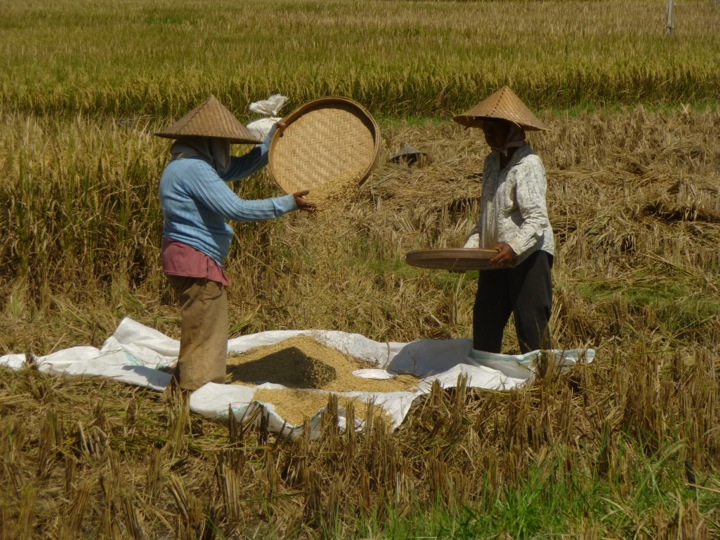
Images are of the cremation tower, an egg artist, and rice workers all from Bali, Indonesia

Posted from Sandakan, Malaysia

Monday, April 29, 2013

The Many Faces of Wayan


As we got ready to travel to Indonesia, we experienced a wonderful feeling of excitement tinged with uncertainty.  During our last 10 months of travel, we were able to relate to the cultures and people of the Americas and of New Zealand and Australia.  We either shared aspects of history (English colonies, world war allies), religion or language (or at least some of the language).  But Indonesia, Malaysia and Southeast Asia were big steps into the unknowns of language, religion, and other elements of culture.

Imagine our surprise, then, to learn that it would be much easier to learn names in Bali, Indonesia than in Australia or New Zealand. There are only four names:  Wayan, Made, Nyoman, and Kedut.  The names are in birth order from the firstborn (Wayan) to the forth child (Kedut).  If families are larger, they begin again at Wayan.  The first two names have possible gender derivatives (Gede for a first born male and Ilu for a female; Kadek for a second born male and Nendah for a female.  One of our many Wayans shared with us that having at least four children was common in the past.  He explained as family planning and birth control became accessible in the last decade or so, most
families are choosing to have two children.  The challenge for some families with only girl children is that it is the sons who stay home, building their own home in traditional Balinese compounds, and caring for the family temple.  Girl children move into the compound of their in-laws.  In a culture that centers each day on their spirituality, ceremonies and rituals in temples, it is vital that the family have sons for the daily activity and care of the temple.

We have been awestruck at the central role that Hindu spirituality plays in the lives of  the people we meet.  We have been humbled by their willingness to share in their ceremonies and their activities.  Their religious life is open, constantly prevalent, and rich.  Most people spend up to 20% of an average annual salary of $1,000 to $1,500 on their ceremonies of names, births, deaths, full moons, calendar days, anniversaries, etc.  Everywhere we walk, food and flowers, and the gods that receive them, are omnipresent.

Just when we thought we were beginning to understand Balinese names, we met Agus and Norman today.   So much to learn, so little time till we move on to Borneo and Malaysia.


Images are of three wonderful Wayans we met.  Our most excellent driver and new friend, a young woman at the restaurant of an Ecolodge where we stayed, and the boat captain who took us out fishing near Amed.

Posted in Lovina, Bali, Indonesia

Thursday, April 18, 2013

Dusk to Dawn


One wonders what pattern of living you might enjoy if completely free to choose.  We have learned to savor dusk and dawn.  We plan trips, outings, and places to stay around opportunities to enjoy twilight times.  Both dusk and dawn are magical transition times in which one world quiets down while the other awakens.   And as you will see below, all species, including our own, are influenced by these special moments of change as the earth fades from or faces the sun each day.
The best example of such transitions might just come from a tiny mining town, Pine Creek, Australia.  Pine Creek has a few hundred people but thousands of birds and bats.  At dusk, for reasons no one really understands, thousands of birds from dozens of species pour into a few trees in a small park.  The glint of the old dying light shines off the crimson bellies of rainbow lorikeets and transforms the metallic aquamarine color of rainbow honeyeaters to an ocean blue in the last rays of sunlight.  The bird chorus rises to deafening proportions as they cry out their final songs into the night and ghostly bats fill the blood orange colored horizon flying in from daytime roosts.  At dawn, the bats ease away and the birds begin their raucous calls an hour before the first glint of sun fills the morning sky.

It is in places like Pine Creek that we have found a passion that causes us to walk into the forest in the dusk, lights turned off unless necessary.  We have held still for the better part of a night listening for the crackling footsteps of one of the kiwi species to emerge on a moonlit trail in New Zealand.  At dawn on a beach in Australia, we searched for and followed tiny flipper prints of hatchling sea turtles emerging at midnight from a nest and racing toward the sea.  In Costa Rica we walked behind a guide and found three- and two-toed sloths moving slowly through the trees.  We observed vipers poised to strike, waiting for the heat signature of a smaller mammalian prey.  In Australia we snuck out onto a canopy bridge and trail walk and found, to our night adjusted eyes' delight, a glen of Gloworms.  Gloworms are fungal larvae that spin single strand webs dangling their attractive nighttime offer of light to unsuspecting moth prey.  The musky smell of decaying Eucalyptus will be imprinted in our memories along with the sight of their blue green lights glowing softly like a tiny field of stars in the forest.

And it is not only the other animal species that attract our attention from dusk to dawn.  Human patterns of vibrant life differ across the world as well.  In Argentina, we cruise the street at 5 am in a taxi heading for the airport to watch the first customers begin to emerge from clubs and tango joints.  We found out, much to our dismay, that even 9 pm was too early for dinner in many places including a restaurant we loved in Buenos Aires.  Yet in New Zealand, hostels close their doors by 6 or 7 pm and in Australia, even on a Saturday night, the miners in Pine Creek call 10 pm a late night.

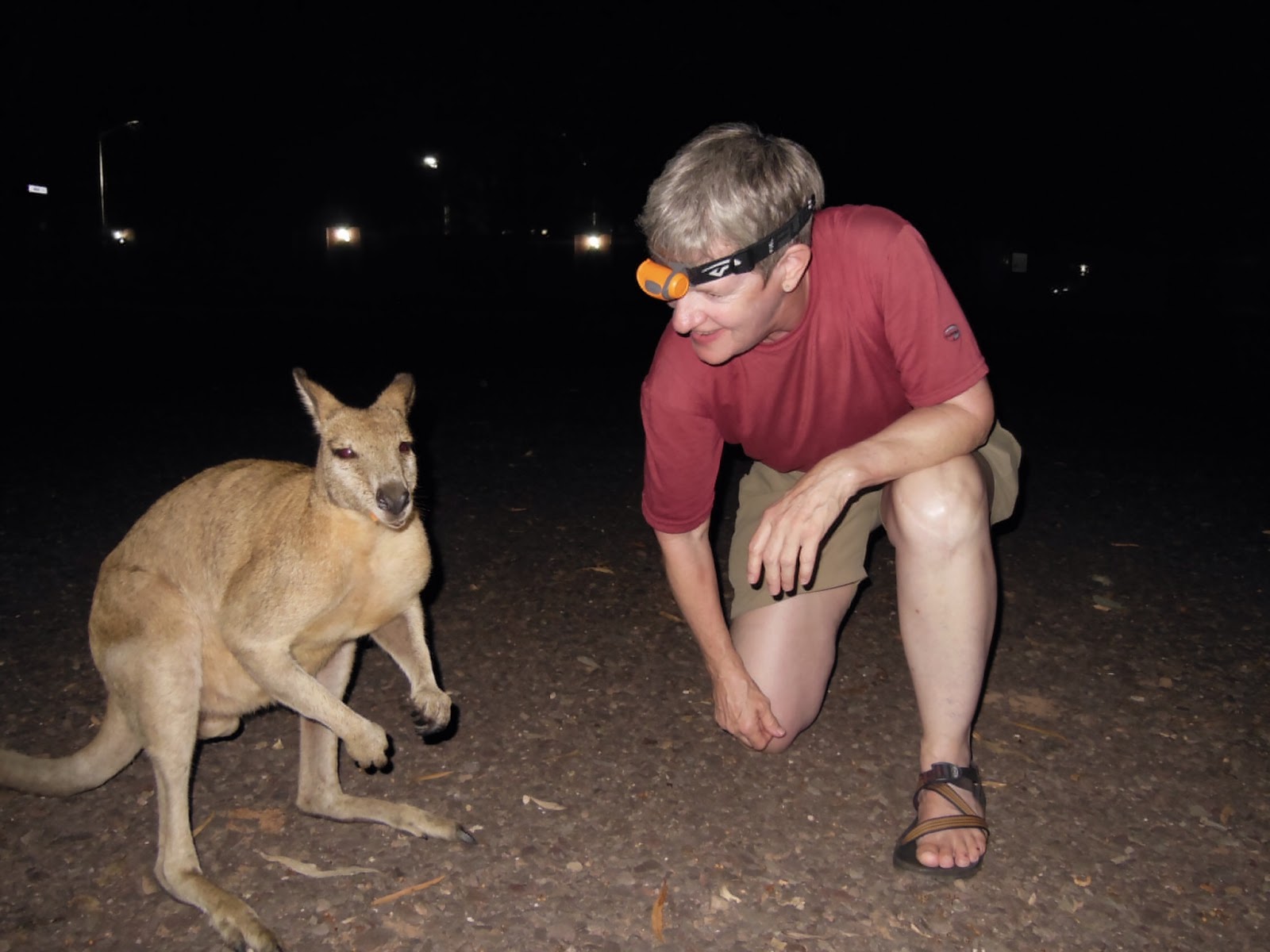
We have purchased a strong light to aid us in our nighttime hunts for koalas, spiders, honey gliders and wallabies.  We have spent many early predawn mornings slipping out of hostels or campgrounds quietly and heading somewhere in the dark to watch one world lie down and another awaken, reborn again. As we prepare for Indonesia and Malaysia, we wonder what will emerge in those distant locales at dusk and dawn.

Images are of a sign near Nimbin, Australia; Sally communing with a wallaby in Katherine Gorge National Park, Australia; and of our first Costa Rica nighttime tour guide at Pasion tours, Marcus, who was training a your apprentice on the arts of insect ID.

Posted in Darwin, Australia

Monday, April 1, 2013

Who are you and what have you done with my partner?


We wanted to share a bit about the origin of our most common, almost daily saying.  "Who are you and what have you done with my partner?"

Who are you....

As I reflect on the past nine months, I realize that Jess has changed.  Actually, we have both amazed each other at times with our ability to adapt to whatever the current situation demands.  Jess, however, has slowly migrated from what her family labeled as "messy Jessie" to "neat complete."  This has led me to ask myself (sometimes with great humor) "Who ARE you and WHAT have you done with my partner?"

In our home life, Jess cooked and I cleaned.  That was due mostly to the fact that I neither liked to cook nor wanted to learn, and Jess loved working in the kitchen, creating wonderful and tasty delights.  As we have traveled together, the same has been true, but because of limited spaces and unique circumstances, we have both found it necessary to assist each other in ways that are not familiar to either of us.  Jess's abilities to put things back where they belong, put lids onto bottles tightly, and keep her gear organized have become phenomenal.  Her prompting me to consider doing laundry when a clean change of clothes still exists has been beyond my comprehension.

Our travels together have only solidified my admiration for this person who means so much to me.  Jess has always been an amazing person, with a calm, confident inner strength that most of us can only dream about.  Her ability to handle multifaceted, difficult, sometimes unpleasant, tasks is mind boggling, as is her incredible ability to work with all types of people.  My role in her life has been one of consistency and stability.....a shoulder to cry on when necessary.  Now, as we share the challenges and rewards of our travels, she has adapted to the necessary, immediate consistency of time and place.  As I watch her rinse out coffee and tea mugs before she puts them away in the car, I smile because there will not be coffee stains on the carpet of the rental car, and the cups will be easily found in the morning as we make our travel beverages.

As I smile at the above descriptions, I reflect on how lucky I am to have found such an incredible person.  Her ability to adapt to my peculiar tendencies has been one of the main stays of our relationship, especially during our travels.  As we travel the world, I sincerely hope I can continuously ask "Who ARE you and WHAT have you done with my partner?" as we both learn, grow, and adapt together.


... and what have you done with my partner?

After more than 20 years of living with another, you come to believe that you know them intimately, thoroughly, and can predict their actions and reactions.  Such are the survival skills of partnership.  So you can imagine our surprise as we began a trip together in a space smaller than our closet and our most common phrase quickly became "Who are you and what have you done with Sally (or Jess)?

We surprised each other.  To best explain how Sally surprised me, one has to understand that for most of her life, she has survived and excelled through consistency.  Such a skill can also lead one to be a bit resistant to change, be a little risk averse, and be conservative.  Somehow, after over 60 years of practicing those traits, she has set them aside.  Sally embraced the idea and action of change as we sold or gave away all that was familiar and hit the road. She is always ready each day for a new place or setting, trying a new food or drink, using wifi, playing words with friends, and showing patience with me, even when I move all of her stuff around and forget to tell her where I put any of it.  She is quick to shrug off the small stuff and thoughtful in facing the big stuff.  And she takes risks.  She takes them emotionally, physically, mentally, and financially as we venture forward.  Life is not always easy as memory fails and hard won physical strength fades with age and such can frustrate.  Yet what really stands out is not what is lost, but what my partner gains each day as she faces a night in a new hostel, a steep and uncertain road, or an urban adventure with the keen curiosity of a child again.

I know that people wondered how we might get along given the tight quarters and intense nature of international travel together. Sure, we occasionally need to talk things through and explain what we need if tensions arise, but most days, in fact every day, I am delighted and honored to travel with someone who understands that to live is to grow.

Posted from Nimbin, NSW, Australia

Monday, March 18, 2013

Karen's Socks

Oh the places they have been... and the things they have seen.  Karen's socks have been on quite a journey since they found their way into new backpacks in Arequipa, Peru.  Karen, a new lifelong friend, heard about Sally's plight of wool allergies and her lack of success in finding quality replacement hiking socks in Peru.  Selflessly, Karen rounded up her Thorlos and set Sally off with a warm heart and warmer feet.  Karen's socks kept Sally's feet comfortable in the unexpected snowstorm on the way to Lake Titicaca.  A few weeks later, as we crept into simple plank beds at almost 16,000 feet near the lagoons and volcanoes of the Uyuni Salt Flats of Bolivia, the socks gave their best through the cold night.  Sliding through muck and mud in the cloud forests the next week and walking the high streets of La Paz were no challenge for these faithful new friends.

The socks really stood up under the test of varying conditions in Patagonia, hanging out in kayaks, hiking glacier trails, and experiencing relatively few sock showers (we call them laundromats) for days or weeks at a time.  Stiffly, they went on toward northern Chile, sometimes hiding in a dark corner of the pack, but more often hanging out of Chacos as we watched folkloric dances and slid into each new dawn in kayaks, busses, or ferries.
The grey and black socks looked almost new after a week of rest in LA, some simple laundry soap, and time to rest.  Forgotten in the pack while their people walked barefoot on the sandy beaches of Rarotonga, Karen's socks waited patiently for their time to tread New Zealand.  Patience is rewarded and the socks dominated the New Zealand days, their stout lengths and tight weave often the only barrier between Jess and Sally and vicious sand flies.   They climbed fearlessly up lava peaks, glaciers, and forest trails saving their quiet, more reflective moments for sitting in kayaks or by baby seals in streams.  They snuck through the night in a dance that can best be described as a combination of blind mans bluff, hide-and-seek, and snipe hunting as they searched for the elusive nocturnal kiwi bird.  And occasionally, they gave way to much less favored pairs to wait their turn at the trail again.

As we travel, we take parts of our friends with us.  Some are physical reminders such as the inches gained from the thoughtful send off treats from Alina, Anthony, Linda, Bill and Dale.  Others are practical such as the emergency bracelet from Sara, Becca and Toni or Karen's socks.  Most of the time, our friends' and families' presence is less tangible but just as real as we think of the time spent with them, see things we know they would love, or hear the things they have taught us about ourselves or the world as we walk new paths each day.

Images are of Karen's socks on the Routeburn track in Milford Sound, New Zealand, under pant legs near Mt Aoraki/Cook and just out of sight of the camera at dusk looking out over the Tasman Sea.  For more about the woman who would give you the socks off her feet read, "Karen's Adventures: My life is a fairy tale" at www.salientmoments.blogspot.com.  Posted at Jarrel's sister's house in Christchurch, New Zealand

Thursday, March 14, 2013

One ring to rule them all

"Even the smallest person can change the course of the future" - Galadriel


OK, we admit it.  We are big fans of "Lord of the Rings" and "The Hobbit," and New Zealand is just the place to immerse ourselves in our love of these movies/books.  For much of the past decade, we gathered as a family with Jack each Christmas season to watch Aragon and Frodo realize their destinies. What we have found to be amazing, though, is the effect that not only these movies, but the legacy of their director, Peter Jackson, have had on this small country. 

Tourism is a vital part of the New Zealand economy.  Of course there are other industries such as agriculture, forestry, and fisheries and all of these in total make for a diverse and usually stable country.  During the last thirteen years, however, tourism has had a significant shot in the arm due, in large part, to the efforts of Sir Peter Jackson.  His trilogy, "Lord of Rings" became so popular that many of the movie locations are advertised and marketed as tourist attractions.  There are tour companies that exist only to provide tours of these sites for the visiting public.  Visitor information centers added personnel to handle the additional visitor traffic seeking anything they could visit concerning the trilogy, and we talked to employees who "had a job because of the trilogy."  Books have been published that detail (with GPS coordinates) site locations of the film and these books can be found in all bookstores and visitor centers across New Zealand.  Things are not slowing down for the movie buffs, as "The Hobbit" locations are now becoming just as popular.

Jackson, along with two other founders, has also located his Weta special effects business in his hometown of Wellington, on the North Island.  This studio/workshop/museum/office is an amazing wonderland that, until recently, was not accessible to the public due to patent concerns.  However, a portion of it is now open for guided tours, and topics such as false faces, armor and swords, stunt doubles, camera tricks, costumes, creation of/aging process of props, etc. are presented, explained and demonstrated----fascinating stuff for those of us who geek out over special effects and the wizards who create them.  Visitors come in droves to this small, inconspicuous building, and spend their vacation money touring this facility as well as for food and lodging in this quaint, bustling little community.


Probably the most surprising aspect of Jackson's influence came to us as a "must see" encouragement from other travelers and locals we met in New Zealand.  We were told more than once as we decided to meander through the wine country in the northern part of the South Island, that the vineyards and wine tasting were good, but the vintage avian heritage center in the same area was fabulous.  "World class" is the term brochures used to describe this museum that Peter Jackson has helped develop, but often we do not agree with the brochures, or with the people we talk to after we have actually visited a site.  However, we decided to see if Jackson's fingerprint could be identified here.  "Surprised" is not nearly a good enough word to explain our experience in this museum as we entered a dark and magical journey in the skies over Europe a century ago.  Jackson, who apparently is a World War I aviation buff, and his Weta studio, put together a fascinating journey beginning with early aviation through World War I with life size planes and figures in dioramas that are as detailed as real life.  There are biographies of many of the pilots, from Eddie Rickenbacker to Baron von Richtoffen. We were mesmerized and amazed as we stepped back in time and lived some of the moments depicted in the dioramas.  It was a stunning and unforgettable experience. The greater unforgettable experience will be a growing understanding of how one person supported by a team of creative geniuses with vision and passion can change the world.  

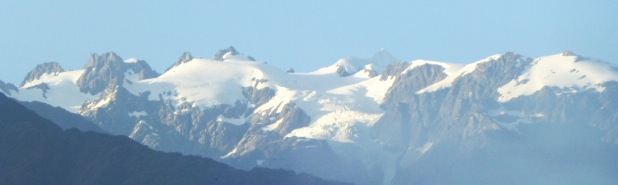
Images are of Frodo's famous hairy feet at Weta Cave, one of dozens of displays at the Avian Heritage Center in Blenhein, and the "Beacons of Gondor" film setting at the Franz Joseph Glacier.

Posted in Moeraki, New Zealand

Monday, March 4, 2013

Invaders

A walk through the California Redwoods puts everything in perspective, gazing at giants that began life as tiny seeds searching for light in a dense forest.  The smell of natural decay in this forest is one of life, rather than death, as the eternal cycle of life continues as it has for eons.  What's wrong with this picture is that we were not in Northern California, rather a few kilometers outside of Rotorua, New Zealand.

One of the strongest patterns we are seeing in our eight months of travel is the stark, all encompassing influence of Homo sapiens.  Humans have, through time, "introduced" to native landscapes many of their favorite aspects of home.  Most times, the introductions have been deliberate attempts to convert a native landscape into something more profitable or familiar; however, many of the introductions of exotics have been accidental.  Whether deliberate or accidental, these introduced species are the single most significant factor to date behind the global extinction and endangerment of native species whether they be one third of all of the extant plant species in Chile, common myna birds on the Cook Islands, or possums in New Zealand.  The local ecosystems and endemic species simply have no tools to resist the onslaught.  For example, myriad flightless birds evolved in the island country of New Zealand in the complete absence of mammalian predators.  Today, rats, cats and possums dominate the landscape necessitating identified zones of poison where air raids rain toxic pellets on the land and bounties are offered on possums to give local species a chance to recover.

While the transformation of the natural world is alarming, we have contemplated the level of cultural contamination as well.  Every country we have been to has a similar story of losing some part of its identity, often with a fight over resources or religion at its center.  Invaders bring disease, war, forced conversion, and extinction to people and cultures that had evolved across millenniums on the land.  Today, that cultural invasion appears to be one of mega corporations, fast food, and pop culture as we find our Monsanto, McDonald's, and music in every region and zone we have traveled.

What is gained from such efforts can be a common appreciation, sense of familiarity, and basic comfort with the known and homogeneous world.  What is lost are the evolutionary branches of organism and cultural diversity that we celebrate in our nature programs and festivals even as they dissolve and disappear. At the beginning, invaders are generally welcomed.  It is often not until all that was special about a place disappears that the invaders are recognized for what they were.

Images are of a poisoned possum, bounty sign on a New Zealand window, and a ubiquitous McDonalds advertisement in South America.  Posted from Franz Joseph Glacier, South Island, New Zealand