Tuesday, July 2, 2013

May I Be Excused?

  
A common question we both remember from our childhood at the dinner table was "May I be excused?"   If there was much on your plate, the answer was typically "no," as parents raised during the depression knew the importance of food in a way that our generation had not experienced.  This nightly reality led to a few "adaptive" behaviors.  For example, Sally became expert at hiding peas and Jess's family dog often lay close to her seat.  The reality of needing to finish every bite did not promote experimentation, despite both of our mothers insisting we try "just a little bit" of everything on the table.

Despite the programming to be cautiously risk averse to new foods, we have loved the opportunity to try new foods as we have traveled this year.  Of course, not every attempt has resulted in new favorites, but all have been interesting and our parents are no longer around to make us finish our plates if we choose poorly.

Overall, we have, much to our chagrin, loved bakeries. We have found tasty treats whether savory or sweet in bakeries all over the world.  We enjoyed them so much that after two months on the road in Alaska and Canada, we weighed ourselves and realized the need for a lot more moderation and hiking.  While we have had some incredible treats in Canada, New Zealand and much of South America, it will be the Filipino bakeries that we will best remember.  Whether simple or fancy, at a bus station or on a promenade, the treats have been delectable.  For all those who are adding ideas to their bucket lists, we contend that we did not truly understand gastric bliss until the meringue cashew filling of a perfect silvana melted in our mouths.

Not all new foraging adventures have ended in moans of culinary rapture.  We have come to recognize that many sea creatures are better left in the ocean than served on our plates.  We have dined on jellyfish, abalone, conch, octopus, squid, and sea cucumbers and found that generally (but not always), the textures overcome the taste.  Yet, raw sea urchin gonads really were tasty, and they mixed nicely with spicy vinegar rice.  While satay sticks are a passion for Jess, even she gave up on the third attempt in Malaysia where the typical satay is chicken tails.  Charred tough skin stretched over globules of yellow fat and soft bones is obviously not for everyone, regardless of the sauces added to them.  Whitebait is a delicacy all over New Zealand.  Yet, when we gazed into the small black eyes of the tiny fish we were to eat whole in our fritter, we paused, blinked, and turned away.

As we prepare to venture deeper into Indonesia, Thailand, Cambodia and Nepal, we know we will continue to pursue our love of sampling local cuisines.  Just don't tell any parents if we leave something on our plates!

Images are of Jess in yet another Filipino bakery; sea cucumber delight; and a white bait fritter from New Zealand.  Posted in Cebu, Philippines

Wednesday, June 26, 2013

The Gringo Trail


One of the best pieces of advice for our journey came from our friend, Phil Crossley.  Unfortunately, we have found it very difficult to follow.  Phil urged us to get off "The Gringo Trail" whenever possible, to explore the corners of the earth that see few tourists and which just might be representative of the people and place in that area.


Such is challenging for two novice world travelers. These are the places with little or infrequent public transport where walking and motorbikes may be the norms but buses and taxis are rare or non-existent.  People are less likely to speak any English in these corners of the world.  Food may be less likely to be prepared in a hygienic way that helps keep us moving fluidly rather than moving fluids.

The Gringo Trail also tends to exist because there are terrific sights and sites to behold.  Think Grand Canyon, Rome's Coliseum, Swiss Alps, the Great Wall of China, etc.  So for much of our first year, we have tread firmly in the footsteps of others on the often slightly polluted, always full, and clearly described tourist tracks in Lonely Planet.  We have tried to ask locals for ideas of things to see that most tourists rush by, but such has been limited to a few hours in a few places...until recently...

In the last couple of weeks, we have begun to find special sites and sights off the beaten track.  On the small island of Bohol in the Philippines, we walked a road for miles where locals
emerged to grin and wave, many asking us "where you going?"  We have taken the time to listen to a local children's choir practice to find to our astonishment it was the world famous, internationally traveled, Loboc's Children Choir.  We stayed a few extra nights to catch the performance of the Loboc Youth Ambassador Band.  Both groups are the inspired vision of music loving locals who mortgaged their business and sacrificed their time to give these children a future.  On Siquijor, we are practicing our motorbike skills (Jess for the first time) and touring smaller, only locally known roads.  We have not seen another non-Filipino tourist in a week.
And soon, we plan on returning to Indonesia.  We loved Bali. However, 80% of Indonesian bound foreign tourists visit only Bali.  There are 17,507 other islands in the fourth most populous country on earth.  These are the islands that helped Alfred Russell Wallace co-develop the theory of evolution as his contemporary colleague, Darwin, pondered his findings from the Galapagos archipelago.  They are the islands where Komodo Dragons roam, living "Hobbits" exist, and the birthplace of spices gracing our kitchen counters.  And...places far from the normal tourist trail.


Images are of our first motorbike ride on Siquijor Island, three young ladies from the Loboc Children's Choir, and typical river transport in the Philippines.  Posted in Larena, Siquijor Island, Philippines

Sunday, June 16, 2013

Hon, My Hat is Mildewing

One morning this week Jess exclaimed "My hat is mildewing!" as she looked in dismay at her relatively new hat purchased a month ago in Malaysia.  While many things differ between our native Gunnison, Colorado and places during our travels abroad, humidity is one of the most significant.  In Gunnison, new arrivals generally have a nosebleed before their first night has passed given the arid and often frigid environment.  Ever since we were in Northern Australia, we have endured a swampy, hot environment in which clothes (and people) never fully dry out.  Add to the mix our penchant to hang out on the beach in these environments, and our non-synthetic clothes begin to rot!

One such place has been the Philippines.  The Philippines are comprised of over 7,000 islands with a varied people speaking over 70 languages.  The primarily Catholic Southeastern Asian country had an interesting mix of first Spanish then US rule during the past four centuries and the smiling, welcoming, resilient people have elements of those as well as other Asian cultures in their everyday life.

As we have described in earlier posts about other places, our time in the Philippines is a series of contrasting experiences.  We may have days in which we are lounging in a resort environment, drinking fruity, happy-hour concoctions and nursing sunburns from too many hours of glorious, snorkeling adventures.  Then there are days like yesterday....

We began the day as we had the previous ones on Malapascua Island without Internet as a storm had knocked it out almost a week earlier.  We walked across the island following young men gracious enough to carry old ladies' backpacks to a small port.  Really, it was a place on the beach where a half dozen sea captains of local bangkas designed to ferry passengers across the sea lounged about waiting for passengers.  Our captain squeezed two dozen of us onto the wood platforms of his trusty banga and set off for the distant shore just under an hour away.  Nowhere were the common sights of fluorescent life jackets on this boat, perhaps attesting to the unique skills of the teen- and preteen- age boys assisting our captain by pumping out water almost, but not quite, as fast as it entered the engine compartment.  The captain and his crew chain-smoked their way across the Philippine Sea with indifference to either the gasoline fumes or hastily tossed propane tanks piled behind them.  Across from us we watched as two young girls picked lice out of each other's hair, a frequent sight on the island with two thousand residents but no doctor or real health care.  A young tourist joined in the grooming, and as they all flung their invertebrate finds into the air we could only hope we were not directly downwind in our nearby seats.  We arrived on land to clamber aboard a local, non-air-conditioned "chicken bus" as we like to call the busses on different continents that transport people and other assorted goods and farm animals.  These busses stop frequently as drivers compete to see which can get the most people squeezed into a small, humid, hot space.  Sharing seats with several others is common.  As we eyed the girls from our boat ride in their nearby seats, we could not help but check the heads of the variety of children placed adjacent or within our laps.  We almost burst out laughing when we heard from the back of the bus a rooster crowing as dusk approached.

Around seven hours after we set out, we arrived in Cebu City to air conditioning, hot water and a nearby mall.  Somehow the easy access to electricity and water was disappointing after days of rationing each and paying for each kilowatt used after the first one at our lodging on Malapascua. Health care and resources are challenging to acquire on most of the inhabited islands in the Philippines and it is so easy to forget that when we arrive at a place where they are at our fingertips.

Whether we are wet or dry, it is the incredible contrasts of our daily lives that educate us on this global journey.  While we could pay more and travel in relative luxury, we often choose the more local route for the experiences and conversations it affords us.  Our stated goal is to learn with humility (and give with grace) and such is hard to do from a fancy, air-conditioned, tourist transport.

Images are from the Philippines and include our most recent "porch" on Malapascua Island, a typical bangka ferry, and the luxurious Sea Dream resort in Dauin, Negros Island.

Posted in Tagbiliran, Bohol Island, Philippines

Saturday, June 8, 2013

Anniversary


We cannot believe a year has passed.  Each day has begun with a prayer.....not generally FROM us, but FOR us and other passengers in the myriad of transports we use.  Whether the drivers are male or female, Buddhist, Muslim, Catholic or Hindu, they pray for a safe journey for themselves as well as for all of their passengers.  And Allah, Buddha, Jesus and Mary must be listening!  We have traveled by banga, jeepney, tricycle, ferry, raft, tube, kayak, canoe, bus, motorbike, and the more conventional planes and autos.  Travel is one of our greatest risks.  The Association for Safe International Travel calculates that we are more than 50 times likely to die of a motor vehicle accident abroad than in the United States.  Walking is not so safe either.  Almost a fifth of all global auto related deaths are pedestrians.  We appreciate all of those prayers and have flung a few skyward ourselves as we teeter on the precipices of roads or wonder why our driver likes to play chicken with large buses and trucks.

The memories from the year are rich beyond our greatest hopes or aspirations.  We have never felt more intensely alive and filled with daily wonder.  Traveling for us has been like a child's first trip to Disneyland.  The characters are bigger than on the little screen and the adventure more divine.  Like Disneyland, there is a wait for the ride, but once it starts, the rules of everyday life are suspended and wonders beyond belief appear at the next turn.

People often ask us what our favorite place has been.  The question is complicated as it is often the people who make the place.  Mate would never have tasted so good unless we were downing a gourdful with Lisbeth, an old acquaintance and new friend.  The spicy, pungent taste of fiery Balinese sauce would have been flatter and less delicious without the company of Wayan and his family; the quiet glory of the dawn kayak less splendid without Irene's face glowing calmly in the early sunrise.

Places speak to our hearts as well, whether we are alone or surrounded by others.  Who can forget the feelings inspired at the first sighting of Machu Pichu?  The tears of emotion were enough to make us realize the place had touched us deeply.  The sheer "hugeness" of the Perito Moreno Glacier, even after having seen magnificent and breath taking glaciers in Canada and Alaska, has stayed with us throughout our travels.  The fact that the glacier is so accessible, talks to the visitors, and frequently calves football field sized chunks of ice all contribute to its special place in our memories.  As a vast, primitive, alpine arctic landscape that makes one feel remote and alone with nature, nothing can top the Dempster Highway in the Canadian Northern Territories.  It teems with wildlife, though viewing any of the creatures is a combination of weather, season, and luck.  The opportunity to swim with creatures as large as three or four trucks lined up end to end has been a highlight of our Philippines travel.  Images of snorkeling with these whale sharks, often referred to as the "gentle giants," will be etched in our memories for the rest of our lives. Whether large as an elephant's, tiny as a baby gecko's, or glowing golden like those of the platypus, it is the eyes of animals that captivate us.  And of course, it is Tamar's eyes, our hitchhiker, that we remember best.


As we extend our visa for a longer stay in the Philippines, we look to the west.  Cambodia, Laos, Myanmar, Thailand and Vietnam are nearby and the call of Everest strengthens each day.  Summer is hot in Southeast Asia.  We will seek the cool nooks and crannies full of new experiences, unmet friends, and opportunities to learn and grow.

Posted in Moalboal, Philippines.  Images are of our tricycle driver who blessed our trip in Dugamente, our friend Irene Grave, and the two of us moments before we jumped in with whale sharks in the Philippines.

Thursday, May 23, 2013

Now I Lay Me Down to Sleep...

Most of our friends and family know where they are sleeping tomorrow night; however, we rarely do.  And we almost never know where we are sleeping next week!  One of the time consuming challenges of our "homeless" journey is providing for a roof over our heads each night.

Some worldly travelers simply arrive at a new destination, wander around sporting large  backpacks, avoiding touts who might take them to seedier, expensive properties, and check likely hostels as they walk.  We have avoided that method for several reasons.  The first and foremost is carrying heavy backpacks up and down broken pavement and slippery boardwalks in temperatures in the 90's with sweat gluing clothes firmly to body parts is not our idea of fun.  Doing so at night creates an aromatic opportunity for various domestic animal feces to embed in one's only pair of hiking shoes.

We also would miss the valued social networking aspect of accommodation reviews.  We have relied heavily on sites such as www.hostelworld.com, www.hostels.com, (both of which have review, availability and bookings) www.tripadvisor.com (reviews), www.wotif.com (Australia's best site), www.airbnb.com (the most eclectic offering), www.lastminutedeals.com, and www.couchsurfing.com (cultural exchange in a home for a few nights).  In all of these, it is interesting to read reviews of previous lodgers who have posted thoughts on their hosts, digs, local color, food, etc.  We don't use guide book recommendations much as they are often out of date and woefully incomplete.

We seek phrases about the warmth, helpfulness, and welcoming vibe of owners and staff.  We are often interested in meeting other travelers so mention of nice common use areas (kitchens, TV rooms, pool areas) that promote such interactions is valuable.  We are mindful of our budget so price is a significant variable as well.  We prefer homestays, hostels and b&b's to most lodges, resorts or hotels.  We appreciate the honest reviews that mention what a "swell party place" it is, the presence of bedbugs, or have titles like "Never Again" or "I would rather sleep on the street".  If there is a pattern of such reviews, we move onward.  We also take advice from other travelers and find places with no web presence, but which have all we need for a night or two.
The culture that develops around lodging within each country is fascinating.  In South America, most hostels ask for payment and passport before the room has been seen by the visitor, yet bed and breakfasts never do.  In South America and Southeast Asia, some form of breakfast is included even at the least expensive and simplest places.  In both New Zealand and Australia, brekkie is typically provided only for an additional charge, yet Australians always provide powdered coffee/tea with cold, fresh milk, and a hot water kettle is ubiquitous in every room.  Checkout time in New Zealand and Australia never varies; it is always 10 am.  In the rest of the world it varies by place and the whims of local management.

The included breakfasts can vary, but each area develops some standards by which the budget places abide.  Sugary, orange flavored drinks are a global morning fixture as are black tea and instant coffee.  Toast or rolls are common as are butter and jam.  In Asia, many places offer a variation of rice or noodles with a fried egg on top.  In slightly more upscale habitations a home cooked breakfast of pancakes or eggs is common and many places in South America added their own touches of fresh fruit, fresh juice and homemade breads.  In Bali, pineapple and banana pancakes were the norm.  Real coffee is rare most of the places we have traveled, and when Jess spies a place that travelers claim provides it, she usually leans toward booking that space over almost any other criteria.

We have been surprised at other local norms as well.  In Southeast Asia, even nicer lodgings typically combine a toilet with a shower in a space too small for either alone.  Bugs are ubiquitous roommates in almost every place within 20 degrees of the equator while air conditioning is a valued treat and fans an absolute necessity.  Some places have widescreen TV with awesome collections of pirated movies and TV shows while others have a simple book exchange.  In third world countries, exposed wires and stairwells which require four limbs and a rope to climb are the norm.  Most places have little sound proofing but the temptation to wear earplugs is supplanted by the desire to hear the cries of "fire," an inevitable companion to the lack of building codes as plug-in devices strain limited electrical systems.

There is something intrinsically thrilling about entering a place that is surprisingly nice and the explorers in us enjoy finding out what we have "bought into" as we move to each new residence. We have quickly learned to exclaim in delight at a bathroom counter, a rarity even in first world countries.  We have learned to never judge a hostel by the exterior.  Occasionally, we choose poorly which makes a particularly wonderful place so much sweeter.  As is true so much in life, it is the trials that lead to the quiet joy of comfort.

Posted in Singapore, Singapore.  Images are of a typical steep hostel staircase, wonderful banana pancakes in Bali, and the common combination of shower and toilet in small spaces in Asia.  

Wednesday, May 8, 2013

Would You Swap?

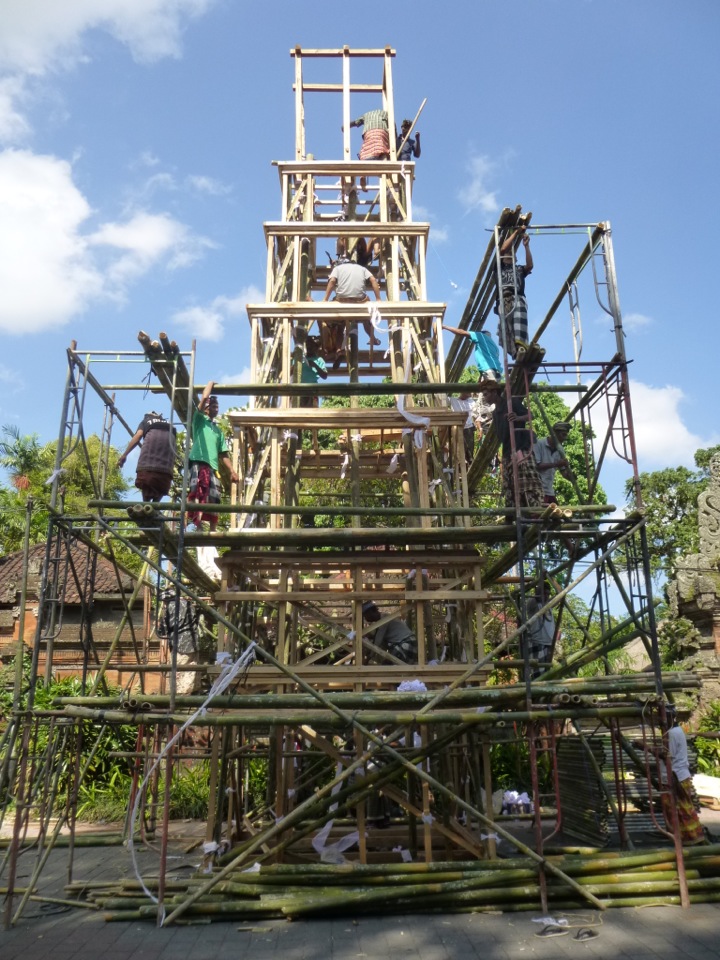
The structure was slowly taking shape as the workers used leaf fiber to secure the bamboo and wood planking to the skeleton already in place.  We stood on the rough sidewalk and watched and were approached by a young man about a taxi ride.  We declined the offer, but struck up a conversation with him about the structure across the narrow street.  Wayan (yes, one of the many) explained that the structure was a cremation tower being built for a member of the royal family.  While no one knew exactly which member of the Royal family had died, the tower construction was the responsibility of a group of families in the town of Ubud, in Bali, Indonesia.  The body will be brought to the tower and placed on top.  The tower will then be carried through town in a procession ceremony, and finally the tower will be set on fire.  As we discussed the cremation ceremony, politics and life with Wayan, we eventually told him how much we were enjoying Bali and what a good time we were having.  We mentioned the people and how friendly they were.  We told him we thought it was one of the best places we had visited on the planet.  A telling moment for both of us came when Wayan asked "Would you swap your life for mine?"  It stopped us dead in our tracks.  As we paused, tongue-tied and silent, he said "I am nothing."

As much as we are enjoying our travels, would we swap our lives with any of the dozens of people we have met along the way?  Many of the people we have met make far, far less than even those considered below the poverty level in the United States.  Infrastructures in many of the countries are extremely inadequate for the masses they are expected to serve.  Even people in first world countries like New Zealand and Australia experience floods, typhoons, earthquakes, and enormous fires and have to deal with the aftermath of those disasters.

This taxi driver is far from "nothing." He was articulate, knew two languages well, was technologically versed, and was thoughtful.  However, his chances of improving his life in a society with a strong caste system and in a country with such poverty are very limited. We like to believe that despite poverty, people are happy.This "Wayan" was not. No, we would not swap our lives....and somehow, that hurts.


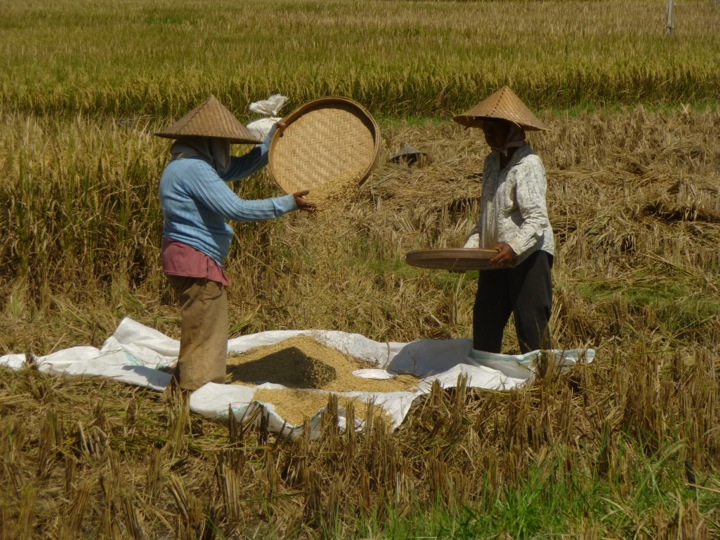
Images are of the cremation tower, an egg artist, and rice workers all from Bali, Indonesia

Posted from Sandakan, Malaysia

Monday, April 29, 2013

The Many Faces of Wayan


As we got ready to travel to Indonesia, we experienced a wonderful feeling of excitement tinged with uncertainty.  During our last 10 months of travel, we were able to relate to the cultures and people of the Americas and of New Zealand and Australia.  We either shared aspects of history (English colonies, world war allies), religion or language (or at least some of the language).  But Indonesia, Malaysia and Southeast Asia were big steps into the unknowns of language, religion, and other elements of culture.

Imagine our surprise, then, to learn that it would be much easier to learn names in Bali, Indonesia than in Australia or New Zealand. There are only four names:  Wayan, Made, Nyoman, and Kedut.  The names are in birth order from the firstborn (Wayan) to the forth child (Kedut).  If families are larger, they begin again at Wayan.  The first two names have possible gender derivatives (Gede for a first born male and Ilu for a female; Kadek for a second born male and Nendah for a female.  One of our many Wayans shared with us that having at least four children was common in the past.  He explained as family planning and birth control became accessible in the last decade or so, most
families are choosing to have two children.  The challenge for some families with only girl children is that it is the sons who stay home, building their own home in traditional Balinese compounds, and caring for the family temple.  Girl children move into the compound of their in-laws.  In a culture that centers each day on their spirituality, ceremonies and rituals in temples, it is vital that the family have sons for the daily activity and care of the temple.

We have been awestruck at the central role that Hindu spirituality plays in the lives of  the people we meet.  We have been humbled by their willingness to share in their ceremonies and their activities.  Their religious life is open, constantly prevalent, and rich.  Most people spend up to 20% of an average annual salary of $1,000 to $1,500 on their ceremonies of names, births, deaths, full moons, calendar days, anniversaries, etc.  Everywhere we walk, food and flowers, and the gods that receive them, are omnipresent.

Just when we thought we were beginning to understand Balinese names, we met Agus and Norman today.   So much to learn, so little time till we move on to Borneo and Malaysia.


Images are of three wonderful Wayans we met.  Our most excellent driver and new friend, a young woman at the restaurant of an Ecolodge where we stayed, and the boat captain who took us out fishing near Amed.

Posted in Lovina, Bali, Indonesia